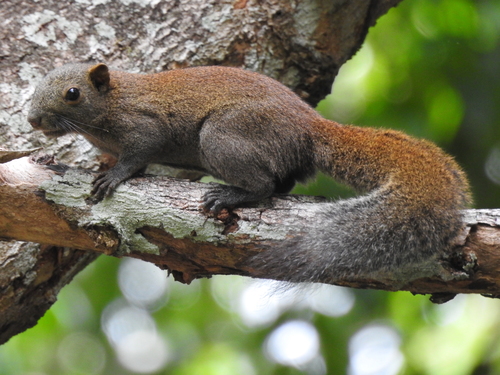
Southern Gray-bellied Squirrel
Callosciurus concolor
A master of the canopy, the Southern Gray-bellied Squirrel is a vibrant and vocal inhabitant of Southeast Asian gardens. With its sleek gray underside and nimble acrobatics, it is a favorite for backyard observers and trail cam enthusiasts alike.
Quick Identification
Size
Body length 18-22 cm (7-9 in); tail 16-20 cm (6-8 in); weight 150-280g (5-10 oz)
Colors
Grizzled olive-brown or gray upperparts with a distinct, uniform pale gray or silvery-gray belly; dark, bushy tail often tipped with black.
Key Features
- Uniform pale gray belly without reddish or buff tones
- Lacks the bold black-and-white side stripes of similar species
- Medium-sized arboreal build with a bushy, slightly tapered tail
- Prominent, dark eyes and rounded ears.
When You’ll See Them
Geographic range
Where Does the Southern Gray-bellied Squirrel Live?
Native to the tropical regions of Southeast Asia, the Southern Gray-bellied Squirrel is most commonly found throughout the Malay Peninsula. Its range extends from southern Thailand down through mainland Malaysia and into parts of the Indonesian archipelago, including Sumatra and its surrounding islands. Because it thrives in disturbed habitats, it is often more abundant in coastal lowlands and suburban areas than in deep, primary rainforests.
Basemap © OpenStreetMap contributors
Behavior
The Southern Gray-bellied Squirrel is a highly active, diurnal mammal known for its incredible agility in the canopy. They are primary arboreal, meaning they spend the vast majority of their lives in trees, leaping between branches with remarkable precision. Unlike some of their more shy forest-dwelling relatives, these squirrels have adapted exceptionally well to human presence, often becoming a familiar sight in suburban gardens, orchards, and urban parks across Southeast Asia.
Socially, they are often seen foraging alone or in pairs. They are quite vocal, utilizing a range of bird-like chirps and rattles to signal alarm or establish territorial boundaries. When threatened by a predator, such as a hawk or a snake, they will flatten themselves against a tree trunk and remain perfectly still, relying on their grizzled gray-brown fur to blend in with the bark.
EverydayEarth exclusive
Camera Tips
To capture the Southern Gray-bellied Squirrel, placement is everything. Since they are strictly arboreal, mounting your camera at ground level will rarely yield good results. Instead, secure your camera to a tree trunk or a sturdy branch about 2 to 3 meters (6 to 10 feet) above the ground. Angle the camera slightly downward along a horizontal branch that looks like a frequently used "squirrel highway."
Baiting is highly effective for this species. A small platform or mesh bag filled with overripe fruit like mangoes, bananas, or jackfruit will act as a powerful lure. If you are in a suburban area, a standard bird feeder filled with sunflower seeds or peanuts will also draw them in regularly. Place the bait roughly 2 meters away from the camera lens to ensure they are in focus when they stop to eat.
Because these squirrels move with sudden, jerky motions, set your camera to its fastest possible trigger speed (ideally under 0.5 seconds). Use a high-speed burst mode (3-5 photos per trigger) to increase your chances of getting a clear shot while they are twitching or leaping. Since they are strictly diurnal, you can save battery life by programming the camera to only operate between sunrise and sunset.
Similar Species
Species that look similar or are commonly confused with Southern Gray-bellied Squirrel.
Frequently Asked Questions
Record Southern Gray-bellied Squirrel at your habitat
Connect a camera to start building your own species record — AI identifies every visitor automatically.