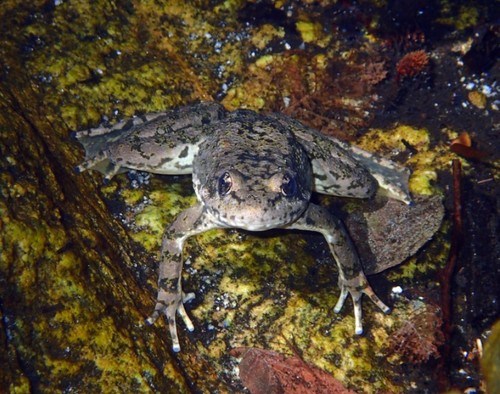
Southern Mountain Yellow-legged Frog
Rana muscosa
A rare gem of the California mountains, the Southern Mountain Yellow-legged Frog is a resilient alpine survivor. Though endangered, this sun-loving amphibian remains a symbol of the wild, high-altitude streams of the Sierra Nevada and Southern California ranges.
Quick Identification
Size
1.5 to 3.25 inches (4 to 8 cm) in length
Colors
Mottled brown, olive, or grey upper body with dark spots; distinct yellow or orange 'wash' on the underside of the belly and hind legs.
Key Features
- Bright yellow or orange coloration on the undersides of hind legs
- Mottled, lichen-like skin pattern on the back
- Relatively short hind legs for a frog of its genus
- Lacks the light-colored jaw stripe found in similar species
When You’ll See Them
Behavior
The Southern Mountain Yellow-legged Frog is a highly aquatic specialist that is rarely found more than a few feet from a permanent water source. Unlike many other frogs that may migrate through meadows or forests, these frogs spend their lives huddled near the edges of high-altitude streams and lakes. They are master sun-bathers, often seen basking on rocks during the warmest parts of the day to regulate their body temperature in the chilly mountain air.
These frogs are remarkably resilient, having adapted to survive in habitats that are covered in snow and ice for much of the year. Because their tadpoles can take up to four years to fully metamorphose into frogs, they require deep water that doesn't freeze solid or dry up. They are generally solitary but can be found in small groups where basking spots are prime. While they are usually quiet, they can produce a soft, clicking call underwater.
EverydayEarth exclusive
Camera Tips
Capturing the Southern Mountain Yellow-legged Frog on camera requires a specialized approach because they are small, cold-blooded, and inhabit sensitive, high-altitude environments. To increase your chances of a sighting, focus your camera placement on 'basking rocks'—flat, sun-exposed stones that sit right at the water's edge. Because these frogs are endangered, it is vital to set up your equipment from a distance to avoid disturbing their habitat or trampling delicate shoreline vegetation.
Since amphibians are ectothermic, traditional PIR (passive infrared) motion sensors on trail cameras may struggle to detect them against the background temperature of a sun-warmed rock. Use a camera with a 'time-lapse' mode or 'hybrid' setting that takes a photo every 1-5 minutes during peak daylight hours. This ensures you catch them while they are stationary and sunning themselves, even if they don't trigger the motion sensor. A camera with a short focal distance or a macro lens attachment is highly recommended to capture the intricate, lichen-like patterns on their skin.
Position your camera low to the ground, roughly 12-18 inches high, angled slightly downward toward the shoreline. Avoid using artificial lures or baits; instead, look for areas with high insect activity, which naturally attracts the frogs. In the Southern California mountains, the best window for photography is immediately following the spring snowmelt when the frogs emerge from hibernation to breed and bask. Always remember to disinfect your gear with a 10% bleach solution before and after visiting aquatic sites to prevent the spread of chytrid fungus, which is a major threat to this species.
Similar Species
Species that look similar or are commonly confused with Southern Mountain Yellow-legged Frog.
Sierra Nevada Yellow-legged Frog
Nearly identical in appearance, but found further north in the Sierra Nevada; distinguished primarily by geographic range and genetic testing.
American Bullfrog
Much larger with a massive, distinct circular eardrum behind the eye and lacks the yellow pigment on the underside of the legs.
California Red-legged Frog
Features reddish coloring on the undersides of the legs rather than yellow, and possesses prominent dorsolateral folds (ridges) down its back.
Frequently Asked Questions
Record Southern Mountain Yellow-legged Frog at your habitat
Connect a camera to start building your own species record — AI identifies every visitor automatically.