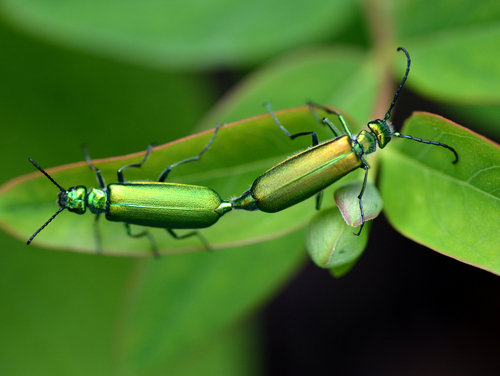
Spanish Fly
Lytta vesicatoria
A shimmering jewel of the insect world, the Spanish Fly is an iridescent wonder with a hidden, toxic punch. Watch these metallic green beetles transform your backyard trees into a glittering display of summer activity.
Quick Identification
Size
12 to 22 mm (0.47 to 0.87 inches) in length; approximately 5 to 8 mm (0.2 to 0.3 inches) in width
Colors
Brilliant, iridescent metallic green or golden-green; sometimes with a bluish tint depending on the light angle
Key Features
- Vibrant emerald-green iridescent body
- Elongated, soft-textured elytra (wing covers)
- Distinctively narrow 'neck' behind the head
- Strong, pungent medicinal odor when disturbed
When You’ll See Them
Geographic range
Where Does the Spanish Fly Live?
The Spanish Fly is primarily native to Southern and Central Europe, where it thrives in warmer temperate climates. Its range extends eastward across Asia into regions of Siberia and the Middle East, reaching as far as Central Asia. While it is widely distributed across the European continent, it is considered rare and localized in Northern Europe and the United Kingdom, where it is restricted to specific southern sites with abundant host vegetation.
Basemap © OpenStreetMap contributors
Behavior
Despite its name, the Spanish Fly is actually a blister beetle. These insects are famous for producing cantharidin, a potent and toxic chemical compound. They are highly gregarious during their adult stage, often congregating in large numbers on the branches of host trees to feed and mate. When threatened, they exhibit 'reflex bleeding,' exuding a yellow fluid from their joints that contains cantharidin, which can cause severe skin blistering in humans and animals.
Their life cycle is one of the most complex in the insect world, known as hypermetamorphosis. After hatching in the soil, the active larvae (triungulins) must find a way to a ground-nesting bee's nest, often by hitching a ride on a foraging bee. Once inside the nest, they undergo several structural changes, transforming from mobile hunters into sedentary larvae that feast on the bee's eggs and pollen stores. Adults are typically seen for only a few weeks in early summer before they perish.
EverydayEarth exclusive
Camera Tips
To capture the Spanish Fly on a backyard camera, you need to look up. Unlike many ground-dwelling beetles, these iridescent insects spend most of their time in the canopy of trees like Ash, Lilac, or Privet. Mount your camera on a high branch or use a tripod with a long-reaching arm to position the lens near fresh leaf growth. Look for signs of 'skeletonized' leaves—where the veins remain but the soft tissue is eaten—as this indicates a nearby feeding colony.
Lighting is the most critical factor when photographing the Spanish Fly. Their metallic carapaces act like tiny mirrors, which can cause harsh reflections and 'blown-out' white spots in bright sunlight. Try to position your camera so the sun is behind you or at a 45-degree angle to the beetle. This side-lighting will bring out the prismatic shifts in color from deep green to bright gold. If your camera has manual settings, slightly underexposing the shot can help preserve the rich, saturated greens of their wings.
Because these beetles are small and fast-moving, use a high motion-sensitivity setting. If you are using a trail camera, a macro lens attachment is highly recommended to get the necessary detail. They are most active on warm, still days; wind will often cause them to huddle in more sheltered parts of the tree where they are harder to spot. If you identify a 'hotspot' tree, leave your camera in place for several days, as the colony will stay in one area until the food source is depleted.
Similar Species
Species that look similar or are commonly confused with Spanish Fly.
Frequently Asked Questions
Record Spanish Fly at your habitat
Connect a camera to start building your own species record — AI identifies every visitor automatically.