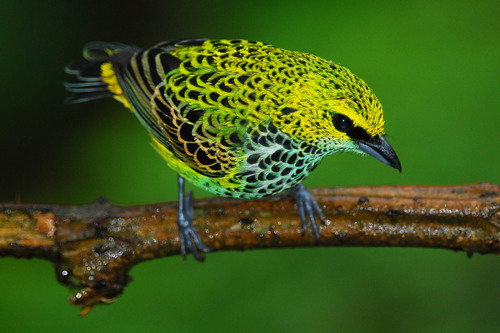
Speckled Tanager
Ixothraupis guttata
A masterpiece of nature's pointillism, the Speckled Tanager is a vibrant green gem of the tropical canopy. These social, high-energy birds bring a splash of color and constant motion to any backyard they visit.
Quick Identification
Size
Length: 12-13 cm (4.7-5.1 in); Weight: 15-22 g (0.5-0.8 oz)
Colors
Brilliant lime-green body covered in dense black spots; yellowish face with a distinct yellow eye-ring; wings and tail edged in pale turquoise-blue. Males and females look similar, though females may be slightly duller.
Key Features
- Heavy black speckling over a bright green base
- Distinctive yellow-green face with yellow eye-ring
- Small, dark, pointed bill
- Turquoise-blue highlights on wing and tail feathers
When You’ll See Them
Behavior
The Speckled Tanager is a high-energy, restless bird often seen flitting through the canopy of tropical forests. They are incredibly active foragers, rarely staying in one position for long as they hop between branches to glean insects from the undersides of leaves or pluck small berries. Their movement is jittery and quick, making them a delightful challenge for backyard observers.
Socially, these birds are rarely solitary. They are quintessential 'joiners,' almost always found as part of mixed-species foraging flocks. You will often see them traveling with other tanagers, honeycreepers, and warblers. While they prefer the mid-to-upper levels of the forest, they are bold enough to descend to lower garden levels if a tempting fruit source is available.
EverydayEarth exclusive
Camera Tips
To capture high-quality footage of the Speckled Tanager, camera placement is critical. These are canopy-dwelling birds, so a camera mounted at eye-level on a second-story balcony or attached to a high tree limb overlooking a garden will be far more effective than a ground-level setup. Angle your camera slightly downward to capture the intricate spotting on their backs, which is their most striking feature from above.
If you want to bring them closer to your AI-powered camera, use a 'spike' feeder with overripe bananas or plantains. Speckled Tanagers have a major sweet tooth and will readily visit a backyard if fruit is consistently provided. Place the fruit near dense foliage; they feel safer when they have a quick escape route into the leaves, which will encourage them to linger longer in front of the lens.
Because these birds are incredibly fast and constant movers, use a fast shutter speed or a high-frame-rate video setting. They tend to 'twitch' while feeding, so short 10-second video clips are often more rewarding than still photos, which can easily result in motion blur. If your camera has a 'burst' mode, this is the time to use it.
Don't overlook water as a lure. Speckled Tanagers are frequent bathers. An elevated bird bath with a small solar-powered dripper or fountain is irresistible to them. The sound and movement of dripping water will draw them down from the canopy, providing you with spectacular action shots as they splash and preen. Ensure the camera is positioned 4-5 feet away from the water to catch the full breadth of the activity.
Similar Species
Species that look similar or are commonly confused with Speckled Tanager.
Golden Tanager
The Golden Tanager is bright yellow rather than green and lacks the heavy black spotting across the entire body.
Bay-headed Tanager
Has a distinct reddish-brown (bay) head and a solid green back without the 'speckled' black dots.
Beryl-spangled Tanager
Features blue-green 'spangles' rather than black spots and typically prefers higher elevations.
Frequently Asked Questions
Record Speckled Tanager at your habitat
Connect a camera to start building your own species record — AI identifies every visitor automatically.