Spotted Barbtail
Premnoplex brunnescens
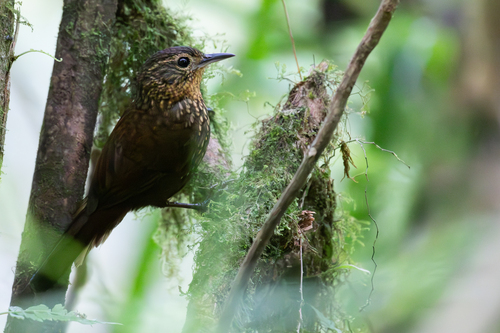
A secretive gem of the Andean mist, the Spotted Barbtail is a master of the mossy understory. With its unique spiny tail and beautifully patterned breast, it brings a touch of highland mystery to every camera sighting.
Quick Identification
Size
13–15 cm (5.1–5.9 in) in length; weighs approximately 14–20 g (0.5–0.7 oz)
Colors
Deep chocolate brown body with prominent buff-colored teardrop spots on the throat and breast; wings and tail are a slightly darker brown
Key Features
- Bold buffy spotting across the throat and chest
- Stiff tail feathers with protruding shafts (barbs) used for climbing
- Fine, needle-like bill for probing moss
- Found primarily in high-altitude cloud forests
When You’ll See Them
Geographic range
Where Does the Spotted Barbtail Live?
The Spotted Barbtail is a specialist of the Neotropical highlands, inhabiting a narrow emerald belt that stretches from Central America into the heart of South America. Its journey begins in the rugged cordilleras of Costa Rica and western Panama, continuing across the Darien Gap into the Andes. It is widely distributed across the montane regions of Colombia, Venezuela, Ecuador, and Peru, eventually reaching its southern limit in the humid forests of Bolivia. This bird is a resident of these misty slopes, rarely wandering far from the specific altitudinal bands where cloud forest conditions are most consistent.
Basemap © OpenStreetMap contributors
Behavior
The Spotted Barbtail is a specialized 'creeper' of the humid montane understory. It spends the majority of its day hitching along mossy tree trunks and thick horizontal branches, using its stiff, spiny tail feathers as a prop, much like a woodpecker or woodcreeper. Unlike many of its relatives, it has a distinct preference for damp environments and is frequently seen foraging near waterfalls, misty ravines, or moss-saturated stream banks.
While it is generally a solitary bird or found in pairs, it is a frequent participant in mixed-species foraging flocks, often following tangaras and other ovenbirds through the forest. It is known for its quiet, unassuming nature; rather than singing loudly, it makes its presence known through short, sharp 'tsip' calls as it moves with jerky, deliberate hops through the dense epiphytes of the cloud forest.
EverydayEarth exclusive
Camera Tips
To capture high-quality footage of the Spotted Barbtail, your AI camera placement should focus on the vertical architecture of the forest. These birds are bark-foragers, so avoid placing cameras on the ground. Instead, strap your camera to a moss-covered trunk about 4 to 6 feet high, or aim it at a large, horizontal mossy limb where the bird is likely to 'hitch' along while searching for insects. Because they love moisture, a tree situated near a stream or a small waterfall is a prime location.
Since the Spotted Barbtail does not visit traditional seed feeders, you can attract them to your camera's field of view by creating a 'natural' lure. A small, solar-powered water dripper aimed at a mossy rock or a shallow stone basin can be irresistible to this species. They are often drawn to the sound of splashing or dripping water for both drinking and bathing. Ensure your camera is positioned to capture the bird's profile, as the spotted breast and stiff tail are its most diagnostic features.
Technical settings are crucial in the dim light of a cloud forest. Use a high-sensitivity ISO setting or ensure your camera has a high-quality infrared sensor for 'no-glow' night or low-light captures. Set your trigger speed to the fastest possible setting; these birds move with a series of quick, sudden hitches and can easily become a blur in slower captures. Because they are active early, ensure your camera's activity window is set to begin at the first hint of dawn.
Similar Species
Species that look similar or are commonly confused with Spotted Barbtail.
Rusty-winged Barbtail
The Rusty-winged Barbtail has bright rufous wings that contrast with its body and lacks the heavy breast spotting of the Spotted Barbtail.
Pearled Treerunner
Pearled Treerunners have much larger, brilliant white pearl-like spots and a more vibrant reddish-brown coloration on the back and tail.
Frequently Asked Questions
Record Spotted Barbtail at your habitat
Connect a camera to start building your own species record — AI identifies every visitor automatically.