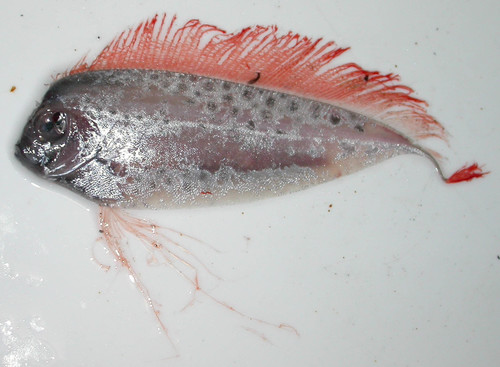
Spotted Ribbonfish
Desmodema polystictum
A shimmering, silver phantom of the deep, the Spotted Ribbonfish is a rare marvel known for its polka-dot patterns and ribbon-like body. Hanging vertically in the darkness of the open ocean, this mysterious wanderer is one of the sea's most elusive treasures.
Quick Identification
Size
Up to 1.1 meters (3.6 feet) in length; extremely thin and ribbon-like body profile.
Colors
Shimmering silver or translucent body; juveniles feature distinct dark brown or black polka dots that fade as they mature.
Key Features
- Elongated, ribbon-like body tapering to a fine point
- Brilliant red or pinkish dorsal fin running the entire length of the back
- Large, prominent eyes adapted for low-light deep-sea environments
- Numerous dark spots (polka dots) scattered across the silver body of juveniles
- Small, highly protrusible mouth used for suction feeding
When You’ll See Them
Geographic range
Where Does the Spotted Ribbonfish Live?
The Spotted Ribbonfish is a circumglobal species that inhabits the temperate and tropical reaches of the world's major oceans. It is most frequently documented in the northwestern Atlantic, throughout the waters of South Africa, and around the coastal regions of New Zealand and Australia. Because it is a deep-water wanderer, it can theoretically appear near any oceanic landmass situated within these warm-to-temperate latitudinal bands.
Basemap © OpenStreetMap contributors
Behavior
While adults are dedicated deep-sea dwellers, juveniles are occasionally swept into shallower coastal waters or found near the surface in the open ocean. They are generally solitary hunters, using their highly sensitive eyes to spot the silhouettes of prey above them. They are not known to be aggressive or interact with humans, and most of what we know about them comes from rare sightings by divers or specimens found after heavy oceanic storms.
EverydayEarth exclusive
Camera Tips
Placement is critical for oceanic filming. Look for regions known for 'upwelling,' where nutrient-rich water is pushed toward the surface, attracting the small fish and squid that the Spotted Ribbonfish preys upon. Because these fish swim with a vertical, undulating motion, standard motion-sensing triggers can be unreliable underwater. It is often better to use a 'time-lapse' mode or continuous recording if battery life allows. Ensure your camera rig is heavily weighted and tethered to a buoy to prevent it from being lost to strong oceanic currents.
For beachcombers, the best 'camera' opportunities happen after a major storm or during an unusual cold-water event. These delicate fish are sometimes washed into tide pools or onto the sand. If you find a specimen, use a macro lens to capture the unique 'polka dot' markings and the structure of the dorsal fin, which are vital for scientific identification. If the fish is still in a tide pool, try to film from the side at water level to document its unique vertical swimming posture before contacting local wildlife authorities or marine biologists.
Similar Species
Species that look similar or are commonly confused with Spotted Ribbonfish.
Frequently Asked Questions
Record Spotted Ribbonfish at your habitat
Connect a camera to start building your own species record — AI identifies every visitor automatically.