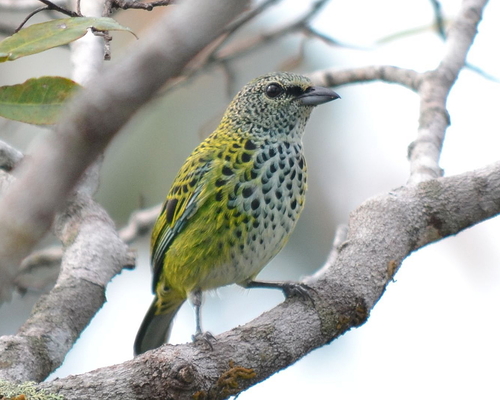
Spotted Tanager
Ixothraupis punctata
Dressed in a shimmering coat of turquoise and jet-black speckles, the Spotted Tanager is one of the most exquisite gems of the South American canopy. Though small in size, its striking pattern makes it a showstopper for any backyard observer lucky enough to spot one.
Quick Identification
Size
Length: 11.5–12.5 cm (4.5–5 inches); Weight: 13–17 g (0.45–0.6 oz)
Colors
Luminous turquoise-green upperparts and breast, heavily marked with distinct black spots. The lower belly and undertail coverts are typically white or pale yellowish.
Key Features
- Dense black heart-shaped spots over a green background
- Whitish or pale yellow lower belly
- Small, pointed black bill
- Short tail and rounded wings
When You’ll See Them
Behavior
The Spotted Tanager is a high-energy acrobat of the tropical canopy. They are rarely seen alone, usually traveling in pairs or as part of large, bustling mixed-species flocks that move through the forest looking for food. Their movement style is quick and nervous; they hop rapidly between branches, often clinging to the undersides of leaves or hanging upside down to reach a particularly juicy berry.
While primarily forest dwellers, they are remarkably adaptable and will frequently visit clearings, forest edges, and mature gardens that offer fruit. They aren't particularly vocal birds, but they maintain contact with their group using thin, high-pitched "tsit" calls that can be difficult for the untrained ear to pick up amidst the forest noise. Unlike some bolder species, they prefer to stay under the cover of foliage, only darting into the open for a quick snack or a dip in a birdbath.
EverydayEarth exclusive
Camera Tips
To capture the stunning detail of a Spotted Tanager’s plumage, camera placement is everything. These birds are canopy-dwellers by nature, so they are much more likely to visit a camera that is mounted high up rather than on the ground. If you have a tree with a horizontal limb roughly 8 to 12 feet off the ground, that is your prime location. Angle your camera slightly downward toward a natural perching spot. Because they are small and fast, ensure your AI camera is set to its highest motion sensitivity to catch them as they dart in and out of the frame.
Baiting is highly effective for this species. They have a massive sweet tooth for tropical fruits. Set up a platform feeder and stock it with sliced bananas, overripe papaya, or halved oranges. The key is consistency; if they find a reliable source of fruit, they will return daily, often at the same time. If you can, position the feeder so it receives bright, indirect morning light. This will illuminate the turquoise edges of their feathers and make the black spots pop in your photos and videos without the harsh glare of direct midday sun.
Water is another powerful lure. Spotted Tanagers are frequent bathers and prefer shallow, elevated water sources over ground-level ponds. A birdbath with a small solar-powered fountain or a "dripper" setup is irresistible to them. The sound of moving water acts as a beacon. Set your camera’s focal point on the edge of the water where they are likely to land before hopping in. Because their bathing sessions are quick and involve a lot of splashing, using a high frame rate or short video bursts will help you get that perfect shot of their shimmering feathers in motion.
Similar Species
Species that look similar or are commonly confused with Spotted Tanager.
Frequently Asked Questions
Record Spotted Tanager at your habitat
Connect a camera to start building your own species record — AI identifies every visitor automatically.