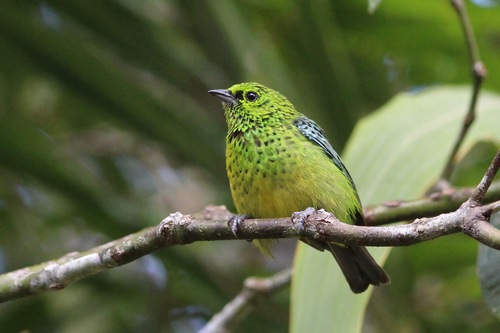
Yellow-bellied Tanager
Ixothraupis xanthogastra
A radiant gem of the Amazonian canopy, the Yellow-bellied Tanager is a master of the treetops. With its sun-bright underbelly and intricate 'scaled' plumage, it offers a stunning reward for any backyard observer with a high-reaching camera.
Quick Identification
Size
Length: 11.5–12.5 cm (4.5–4.9 in); Weight: 15–21 g (0.5–0.7 oz)
Colors
Bright yellow belly and vent; yellowish-green head and chest; emerald green upperparts with heavy black scaling; black wings and tail.
Key Features
- Vivid yellow central belly and undertail coverts
- Heavy black spotting or 'scaling' on the back and breast
- Yellowish-green face and crown
- Short, thick black bill
When You’ll See Them
Behavior
The Yellow-bellied Tanager is a high-energy socialite of the tropical canopy. Frequently found in the upper levels of humid forests, these birds rarely travel alone. They are almost always seen in pairs or small family groups, and they are enthusiastic participants in mixed-species foraging flocks, often trailing behind honeycreepers and other tanagers as they move through the treetops.
Despite their bright colors, they can be difficult to spot from the ground because they spend much of their time obscured by dense foliage. They move with a restless, hopping gait, constantly scanning the undersides of leaves for insects or reaching for small berries. They are not particularly shy of humans but generally maintain their distance by staying high in the trees, only descending to lower levels at forest edges or near garden feeders.
EverydayEarth exclusive
Camera Tips
Capturing the Yellow-bellied Tanager requires getting your equipment off the ground. Because this species is a canopy specialist, a camera mounted at eye level will likely only catch fleeting shadows. To get professional-grade shots, we recommend mounting your AI-powered camera 10 to 15 feet high on a tree trunk or specialized pole, overlooking a known fruiting tree or a high-altitude platform feeder. Angle the lens slightly downward to ensure the bright yellow belly is visible, as this is their most identifying feature from below.
To lure them into the camera's frame, focus on their love for soft fruits. Platform feeders stocked with sliced bananas, halved papayas, or overripe oranges are irresistible to them. If you are setting up in a more natural forest setting, look for Miconia shrubs or other native plants with small blue or black berries. Position your camera approximately 4 to 6 feet away from the fruit source to allow the AI to trigger accurately without cutting off the bird's tail or wings during movement.
Timing and settings are critical for these fast-moving birds. They are most active in the first three hours of daylight when the light is softest. Avoid placing cameras where they face directly into the rising sun, as the backlight will wash out the intricate black 'scaling' on their green feathers. Use a 'Burst Mode' setting if available; these birds rarely sit still for more than a second, and a rapid-fire sequence of 3–5 photos will increase your chances of capturing a clear, blur-free image of them in mid-hop.
Similar Species
Species that look similar or are commonly confused with Yellow-bellied Tanager.
Frequently Asked Questions
Record Yellow-bellied Tanager at your habitat
Connect a camera to start building your own species record — AI identifies every visitor automatically.