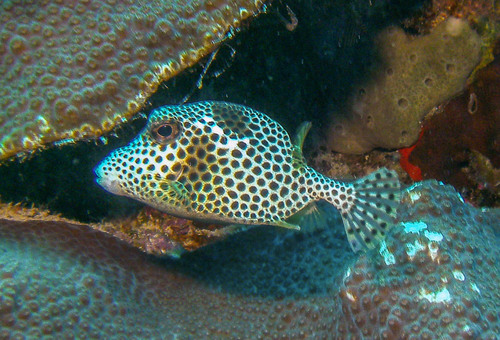
Spotted Trunkfish
Lactophrys bicaudalis
Decked out in bold polka dots and encased in a triangular suit of armor, the Spotted Trunkfish is one of the Caribbean's most charming and geometrically unique reef residents.
Quick Identification
Size
Typically 15-30 cm (6-12 inches) in length, with a maximum size reaching up to 48 cm (19 inches).
Colors
Creamy white to golden-yellow body covered in uniform black spots; whitish area around the mouth and tail base.
Key Features
- Rigid, triangular bony body (carapace)
- Heavy pattern of black spots covering the body, tail, and fins
- Small, puckered mouth used for blowing water into sand
- Lacks the 'horns' found on related cowfish species
When You’ll See Them
Sightings on EverydayEarth
Aug 1, 2026
In a sunny, shallow reef area with a sandy floor, a Spotted Trunkfish swims slowly across the frame, showcasing its black-spotted pattern. The footage then transitions to a deeper, blue-water environment along a steep reef wall, where a school of Bar Jacks and a bright Atlantic Blue Tang swim past coral formations.
Geographic range
Where Does the Spotted Trunkfish Live?
The Spotted Trunkfish is a staple of the tropical Western Atlantic's marine ecosystems. Its primary range extends throughout the Caribbean Sea, the Gulf of Mexico, and the Bahamas, reaching as far north as the Florida coast and Bermuda. To the south, they are commonly found along the shores of Central America and down the Atlantic coast of South America as far as Brazil. While they are strictly saltwater residents, they are most abundant in the coral-rich waters of the Antilles.
Basemap © OpenStreetMap contributors
Behavior
The Spotted Trunkfish is a slow-moving, methodical swimmer that relies on its unique 'puffer-style' propulsion. Because its body is encased in a rigid, bony armor called a carapace, it cannot flex its torso to swim like other fish. Instead, it sculls its dorsal, anal, and pectoral fins to hover and maneuver with surprising precision, using its tail mainly as a rudder or for occasional bursts of speed.
These fish are generally solitary and somewhat shy, often turning their tails toward divers and drifting away when approached. However, they possess a potent chemical defense system. When highly stressed or threatened, they can exude a toxic mucus called ostracitoxin from their skin. In the wild, this deters predators, but in enclosed spaces, it can be lethal to other marine life.
Socially, they are non-aggressive and spend most of their daylight hours focused on the substrate. They are often followed by 'shadow' species like wrasses, which wait to snatch up small organisms that the trunkfish disturbs while foraging in the sand or reef rubble.
EverydayEarth exclusive
Camera Tips
Photographing Spotted Trunkfish with underwater AI cameras requires a strategic approach to their shy nature. The best placements are 'cleaning stations'—specific spots on the reef where small shrimp and wrasses remove parasites from larger fish. Trunkfish will often hover motionless at these stations for several minutes, providing the perfect window for a high-resolution capture. Set your camera at a slight upward angle (15-20 degrees) to capture the unique triangular profile of their carapace against the lighter water column.
Because trunkfish move via rapid fin oscillations while keeping their bodies still, you need a fast shutter speed (at least 1/250s) to prevent the fins from appearing as a blurry mess, even if the body is sharp. If your camera is in a stationary housing, aim it at sandy patches adjacent to reef structures. This is where they perform their 'hydraulic foraging'—blowing water into the sand—which creates a visually interesting behavior for the AI to log.
Lighting is critical for this species. Their black-on-white pattern can cause exposure issues; use a diffuser on your strobes or video lights to avoid 'hot spots' on their reflective scales. In shallow water, midday sun provides the best natural contrast for the AI to recognize the individual spot patterns. Avoid using bait that creates a 'feeding frenzy,' as the Spotted Trunkfish is easily intimidated by faster, more aggressive fish and will likely retreat into a reef crevice if the area becomes too chaotic.
Similar Species
Species that look similar or are commonly confused with Spotted Trunkfish.
Frequently Asked Questions
Record Spotted Trunkfish at your habitat
Connect a camera to start building your own species record — AI identifies every visitor automatically.