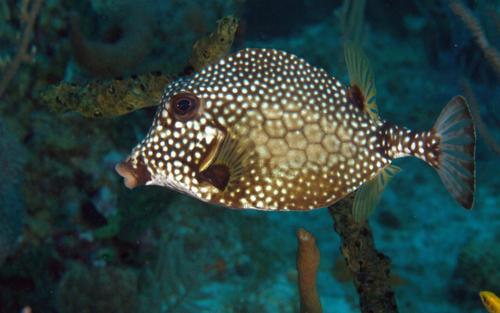
Smooth Trunkfish
Lactophrys triqueter
With its boxy frame and polka-dot pattern, the Smooth Trunkfish is the ocean's most charming 'stinkpot.' This triangular reef dweller is famous for its curious nature and its clever habit of blowing bubbles in the sand to find a snack.
Quick Identification
Size
Typically 20 to 30 cm (8 to 12 inches); maximum length of 47 cm (18.5 inches).
Colors
Dark brown, black, or grey base color covered in a dense pattern of small white spots; features a subtle hexagonal scale pattern and often yellow coloration around the mouth.
Key Features
- Distinct triangular body shape in cross-section
- Rigid, bony carapace instead of flexible scales
- Small, protruding yellow mouth
- White spots on a dark background
- Lacks the 'horns' found on cowfish species
When You’ll See Them
Geographic range
Where Does the Smooth Trunkfish Live?
The Smooth Trunkfish is a quintessential resident of the Western Atlantic Ocean's tropical corridors. Its presence is most heavily concentrated throughout the Caribbean Sea and the Gulf of Mexico, extending north into the warm waters of Florida and the Bahamas. To the south, its range follows the coastline of Central America down to the tropical reefs of Brazil, where it thrives in clear, shallow waters away from heavy siltation.
Basemap © OpenStreetMap contributors
Behavior
The Smooth Trunkfish is a slow-moving, inquisitive reef inhabitant that relies on its bony exterior for protection rather than speed. Unlike many fish that use their tails for propulsion, the trunkfish swims using a method called 'ostraciform' locomotion, where it scuttles through the water by rapidly fluttering its dorsal and anal fins. This gives it a hovering, helicopter-like appearance as it navigates the complex structures of the coral reef. When threatened, they are capable of a sudden burst of speed using their tail, but they generally prefer to rely on their hard armor and a chemical defense—secreting a toxic mucus known as pahutoxin to ward off predators.
These fish are most famous for their unique 'hydraulic' hunting technique. They hover over sandy patches and blow a jet of water from their mouths to uncover buried invertebrates. This behavior often attracts a following of smaller opportunistic fish who hope to snag any scraps the trunkfish misses. While they are mostly solitary, they are often quite curious about humans and will frequently approach divers or underwater camera rigs to investigate their reflection or the equipment itself.
EverydayEarth exclusive
Camera Tips
To capture high-quality footage of a Smooth Trunkfish with an AI-powered underwater camera, you should target 'halos' in the sand near reef edges. These circular, cleared patches are evidence of their foraging behavior. Place your camera on a weighted base or a short tripod roughly 6 to 12 inches above the seabed, angling the lens slightly downward toward a patch of sandy bottom nestled between coral heads. This positioning captures their iconic 'water-jetting' behavior as they search for food.
Lighting is the most significant challenge when filming this species. Because they are often dark with small white spots, they can appear as a silhouette against bright sand. For the best results, use your camera during the peak of the day when the sun is directly overhead to minimize shadows. If you are using artificial lights, mount them wide and at a 45-degree angle to the lens; this prevents 'backscatter,' which occurs when light reflects off the floating particles common in the trunkfish's sandy habitat.
Trunkfish are highly territorial and curious, meaning they will often return to the same foraging spot throughout the day. You don't necessarily need bait, but a small amount of crushed shellfish or shrimp placed in a mesh feeder can keep them in front of the lens for extended periods. Setting your camera to a higher frame rate (at least 60fps) is recommended, as it allows you to see the intricate, rapid vibrations of their translucent fins that appear as a blur at lower speeds.
Lastly, ensure your camera's AI is trained to recognize geometric shapes, as the trunkfish's triangular silhouette is its most identifying feature from a distance. If the water is particularly clear, a side-profile shot is best to showcase the hexagonal pattern of its scales, which creates a beautiful 'honeycomb' effect on high-resolution sensors.
Similar Species
Species that look similar or are commonly confused with Smooth Trunkfish.
Spotted Trunkfish
The Spotted Trunkfish has two sharp spines located just in front of its anal fin, which are entirely absent on the Smooth Trunkfish.
Scrawled Cowfish
Easily distinguished by the two prominent 'horns' over its eyes and blue iridescent scrawled markings instead of simple white spots.
Buffalo Trunkfish
Has a much higher, more arched back and a pattern that often includes larger, more irregular blotches rather than uniform small spots.
Frequently Asked Questions
Record Smooth Trunkfish at your habitat
Connect a camera to start building your own species record — AI identifies every visitor automatically.