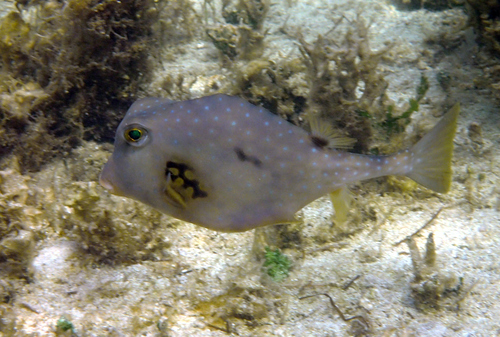
Buffalo Trunkfish
Lactophrys trigonus
Meet the armored architect of the Atlantic reefs. Encased in a rigid, triangular shell, the Buffalo Trunkfish uses hydraulic 'water jets' to hunt for hidden treasures in the sand.
Quick Identification
Size
Typically 30 to 45 cm (12 to 18 inches) in length; weighs approximately 1.5 to 2.5 kg (3.3 to 5.5 lbs).
Colors
Olive, tan, or green body with distinct honeycomb-like hexagonal patterns and two prominent dark, smudged blotches on the sides.
Key Features
- Triangular-shaped bony carapace
- Small, protruding mouth used for 'spitting' water
- Pectoral-fin driven propulsion
- Two dark mid-body blotches
- Hard, non-flexible armored body
When You’ll See Them
Geographic range
Where Does the Buffalo Trunkfish Live?
The Buffalo Trunkfish is a staple of the Western Atlantic Ocean's vibrant reef systems. Its native range begins as far north as the waters off Massachusetts in the United States—though it is more common from Florida southward—and extends through the Gulf of Mexico and the entire Caribbean Sea. This species is frequently encountered along the coastlines of Central America and the West Indies, with its southern limit reaching the tropical waters of Brazil.
Basemap © OpenStreetMap contributors
Behavior
The Buffalo Trunkfish is a slow-moving, methodical swimmer that relies on a specialized form of locomotion called 'ostraciiform swimming.' Because its body is encased in a rigid, bony shell known as a carapace, it cannot flex its torso to swim like other fish. Instead, it uses its pectoral, dorsal, and anal fins like small oars to scull through the water, allowing it to pivot and hover with high precision among coral heads and seagrass blades.
These fish are expert benthic hunters with a unique foraging strategy. They are often seen hovering nose-down over sandy patches, blowing powerful jets of water from their mouths into the substrate. This hydraulic action uncovers buried invertebrates like worms and crustaceans. While generally docile, they are famous for their chemical defense; when threatened, they can excrete a toxic mucus called ostracitoxin from their skin, which can be lethal to potential predators in the immediate vicinity.
EverydayEarth exclusive
Camera Tips
To capture high-quality footage of a Buffalo Trunkfish, you will need a dedicated underwater action camera or a trail camera with a waterproof housing rated for at least 30 feet. These fish spend most of their time near the seabed, so the best camera placement is on a weighted low-profile tripod or a sand-screw mount. Position the lens about 1 foot above the ocean floor, angled slightly upward to capture the fish's unique triangular silhouette against the lighter water column.
Lighting is the most critical factor when filming underwater. If you are setting up a stationary camera in a seagrass bed, try to do so during the middle of the day (10 AM to 2 PM) when the sun is directly overhead to maximize natural light penetration. If you are using artificial lights, place them at a 45-degree angle away from the lens to minimize 'backscatter,' which occurs when the light reflects off floating particles and makes the water look murky.
Trunkfish are curious but cautious. You can encourage them to visit your camera site by scouting for 'blow holes' in the sand—small depressions where they have recently been foraging. Placing your camera near the edge of a seagrass-to-sand transition zone is highly effective. Avoid using heavy baits, as these often attract larger, aggressive fish that will chase the trunkfish away. Instead, a slight disturbance of the sand near the camera can be enough to pique their interest as they investigate for uncovered prey.
For video settings, use a frame rate of at least 60fps. Because Buffalo Trunkfish use rapid, fluttering fin movements to stay stable, standard frame rates often result in blurry fins. A higher frame rate allows you to slow the footage down in post-production, highlighting the incredible mechanical precision of their swimming style. Ensure your white balance is set to 'Underwater' or 'Cloudy' to help counteract the blue-green tint of the water and bring out the subtle yellow and olive tones of their carapace.
Similar Species
Species that look similar or are commonly confused with Buffalo Trunkfish.
Scrawled Cowfish
Look for two prominent horn-like spines over the eyes and a much longer, flowing tail.
Smooth Trunkfish
Smaller in size with a dark body covered in white spots, lacking the large dark side blotches of the Buffalo Trunkfish.
Spotted Trunkfish
Distinguished by a pattern of small black spots on a white background covering the entire body, including the fins.
Frequently Asked Questions
Record Buffalo Trunkfish at your habitat
Connect a camera to start building your own species record — AI identifies every visitor automatically.