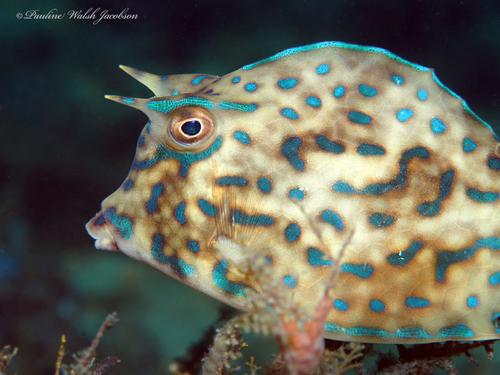
Scrawled Cowfish
Acanthostracion quadricornis
With its characteristic 'horns' and neon-blue scrawls, the Scrawled Cowfish is the armored knight of the seagrass meadows. A slow and steady swimmer, this unique fish brings a touch of prehistoric wonder to coastal backyards and docks.
Quick Identification
Size
Typically 20 to 38 cm (8 to 15 inches) in length; maximum recorded length of 55 cm (22 inches). Weight usually ranges from 1 to 2.5 kg.
Colors
Tan, yellow, or olive-green base covered in intricate, scrawled patterns of iridescent blue or dark brown; distinctive blue spots on the tail and fins.
Key Features
- Two sharp 'horns' protruding from above the eyes
- Two additional spines at the rear corners of the body
- Rigid, box-like body structure composed of bony plates
- Small, puckered mouth with fleshy lips
- Honeycomb-like hexagonal patterns on the skin
When You’ll See Them
Geographic range
Where Does the Scrawled Cowfish Live?
The Scrawled Cowfish is a vibrant resident of the Western Atlantic Ocean, primarily thriving in the warm, tropical and subtropical waters of the Americas. Its native range begins as far north as Massachusetts and Bermuda, extending south through the Gulf of Mexico and the Caribbean Sea to the southern coast of Brazil. While they are most concentrated in the coral-rich waters of Florida and the Bahamas, they are frequently sighted along the coastlines of Central American countries and the northern shores of South America.
Basemap © OpenStreetMap contributors
Behavior
The Scrawled Cowfish is a slow-moving, methodical swimmer that relies on its dorsal, anal, and pectoral fins for propulsion, a style known as ostraciiform swimming. Because their bodies are encased in a rigid, bony 'carapace,' they cannot wiggle like most fish and instead move with a charming, almost robotic precision. They are generally solitary and non-aggressive, spending much of their day hovering over the seabed or weaving through seagrass blades in search of food.
When threatened, these fish have a fascinating defense mechanism. While they lack the ability to puff up like pufferfish, they can release a toxic mucus called ostracitoxin from their skin when highly stressed, which can be lethal to other fish in confined spaces. In the wild, they usually rely on their armored skin and sharp horns to deter predators. They are curious but cautious around humans, often maintaining a fixed distance from divers or underwater cameras while keeping a watchful eye on the intruder.
EverydayEarth exclusive
Camera Tips
Capturing the Scrawled Cowfish requires an underwater camera setup, making it an excellent target for 'dock cams' or weighted trail cameras in coastal backyards. For the best results, mount your camera to a dock piling or a weighted tripod placed near the edge of a seagrass bed. These fish are highly attracted to the transition zones between sandy bottoms and vegetation, where they do most of their foraging. Aim the camera at a slight downward angle toward the seabed to capture their unique 'blowing' feeding behavior.
Natural light is your best friend when filming this species, as their iridescent blue markings only truly pop under bright conditions. Shallow water placement (3-6 feet deep) ensures plenty of sunlight penetration. If you are using an AI-powered camera like those supported by EverydayEarth, the Scrawled Cowfish's distinct boxy silhouette and slow movement make it one of the easiest fish for computer vision models to identify and track without motion blur.
While we don't recommend traditional baiting which can disrupt the ecosystem, placing your camera near a natural structure like an oyster reef or a submerged log will increase your chances. These fish are territorial and will often visit the same 'patrol' spots daily. Setting your camera to record during the middle of the day when the sun is directly overhead will provide the best color saturation for their complex 'scrawled' patterns. Be sure to clean your lens housing weekly to prevent algae buildup, which can confuse AI detection and degrade image quality.
Similar Species
Species that look similar or are commonly confused with Scrawled Cowfish.
Honeycomb Cowfish
Features a pattern of distinct dark hexagons rather than wavy lines, and lacks the bright blue spots often seen on the Scrawled Cowfish.
Buffalo Trunkfish
Has a much higher 'humped' back and lacks the prominent horns above the eyes found on the cowfish.
Smooth Trunkfish
Recognizable by its dark body with white spots and the complete absence of horns above the eyes.
Frequently Asked Questions
Record Scrawled Cowfish at your habitat
Connect a camera to start building your own species record — AI identifies every visitor automatically.