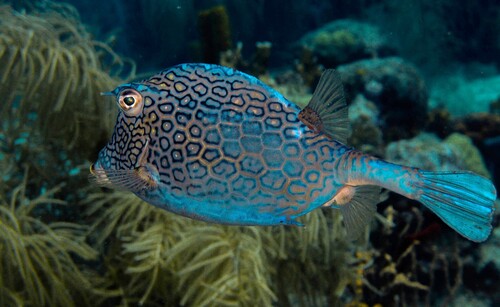
Honeycomb Cowfish
Acanthostracion polygonium
A geometric masterpiece of the Caribbean, the Honeycomb Cowfish is a living box-shaped wonder. With its distinctive 'horns' and intricate hexagonal patterns, it drifts through the reef like a slow-moving work of art.
Quick Identification
Size
Typically 25-40 cm (10-16 inches) in length, with a maximum recorded length of 50 cm (20 inches). Weight generally ranges from 1-2 kg (2.2-4.4 lbs).
Colors
Features a base of pale tan, yellow, or blue-green covered in a distinct network of dark-edged hexagonal scales. They can subtly change their color intensity to blend with the reef background.
Key Features
- Hard, triangular bony carapace protecting the body
- Two prominent horn-like spines over the eyes
- Intricate honeycomb or polygonal pattern on the skin
- Small, pointed mouth with fleshy lips for suction feeding
When You’ll See Them
Geographic range
Where Does the Honeycomb Cowfish Live?
Native to the warm tropical and subtropical waters of the Western Atlantic Ocean. Their range begins as far north as New Jersey in the United States and extends through the Caribbean Sea and the Gulf of Mexico down to the coast of Brazil. They are most commonly encountered in the coral-rich waters of the West Indies and the Florida Keys.
Basemap © OpenStreetMap contributors
Behavior
The Honeycomb Cowfish is a slow-moving, methodical resident of the reef, known for its unique hovering style of swimming. Because its body is encased in a rigid, bony box called a carapace, it cannot flex its torso to swim like most fish. Instead, it relies on 'ostraciform' swimming, using its dorsal, anal, and pectoral fins to scull through the water with remarkable precision. This allows it to hover in place while inspecting the seabed for food.
Generally solitary and shy, these fish are curious but will keep a safe distance from divers. They are highly territorial during certain times and spend their daylight hours foraging along the bottom. When threatened, the Honeycomb Cowfish can secrete a toxic mucus from its skin that can be lethal to other fish in confined spaces, serving as a powerful chemical defense against predators.
EverydayEarth exclusive
Camera Tips
To capture high-quality footage of a Honeycomb Cowfish, you should position your underwater camera near 'cleaning stations' or large, solitary sponges. These fish are creatures of habit and often patrol the same sections of the reef edge daily. Setting your camera on a weighted tripod 1-2 feet above the seabed, angled slightly downward, will capture their natural foraging behavior as they blow water into the sand.
Because the Cowfish has a highly reflective, iridescent scale pattern, avoid using direct, high-intensity artificial lights at night, which can cause 'washout' in your images. During the day, position the camera with the sun at your back to highlight the intricate blue and tan hexagonal patterns. If your camera has a macro or close-focus mode, use it; these fish are slow enough that a stationary camera can get incredible detail of their geometric skin.
Patience is key with this species. They are easily spooked by rapid movement, so a stationary, unattended trail camera is actually more effective than a handheld one. Look for sandy 'blow-holes' in the seabed—small depressions where they have clearly been foraging—and set your camera to record 30-second clips to catch the full sequence of their unique feeding method.
Similar Species
Species that look similar or are commonly confused with Honeycomb Cowfish.
Frequently Asked Questions
Record Honeycomb Cowfish at your habitat
Connect a camera to start building your own species record — AI identifies every visitor automatically.