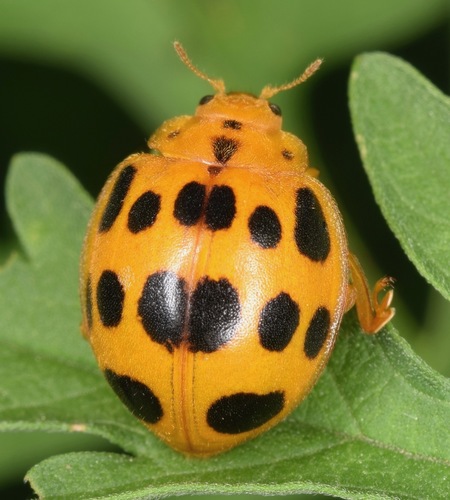
Squash Lady Beetle
Epilachna borealis
The Squash Lady Beetle is a bold, spotted herbivore that turns the 'beneficial ladybug' narrative on its head. With its striking yellow shell and unique feeding habits, it is a captivating subject for any backyard macro-photographer.
Quick Identification
Size
7–10 mm (0.28–0.40 inches) in length; significantly larger than common predatory ladybugs.
Colors
Bright yellow to golden-orange base; 14 large black spots on the wing covers and 4 small black spots on the pronotum.
Key Features
- Seven large black spots on each wing cover (elytron)
- Four small black spots arranged in a pattern on the shield behind the head
- Hemispherical, dome-shaped body
- Yellow larvae covered in long, branched black spines
When You’ll See Them
Geographic range
Where Does the Squash Lady Beetle Live?
Native to the North American continent, the Squash Lady Beetle is primarily established throughout the eastern and central United States. Its core range extends from the Atlantic coast westward to the Great Plains, and as far north as southern Ontario and Quebec in Canada. While less common in the arid West, it is a frequent resident in any temperate region where its preferred host vegetables are cultivated in backyard gardens and agricultural fields.
Basemap © OpenStreetMap contributors
Behavior
The Squash Lady Beetle is a fascinating outlier in the ladybug family. While most ladybugs are celebrated by gardeners as predatory heroes that eat aphids, this species is strictly herbivorous. They spend their days browsing the leaves of cucurbits, often moving slowly across the undersides of foliage to avoid predators and the direct heat of the midday sun. Unlike the frantic flight of some beetles, the Squash Lady Beetle is somewhat sluggish, relying on its bright warning coloration to signal its unpalatability to birds.
These beetles exhibit a unique feeding behavior known as 'trenching.' Before settling down to a meal, they often chew a circular or semi-circular trench into the leaf. This behavior is believed to cut off the flow of chemical defenses (like bitter cucurbitacins) from the rest of the plant, allowing the beetle to feast on the isolated tissue in peace. In the winter, adults seek shelter in leaf litter or under the bark of nearby trees, emerging in late spring to begin the cycle anew on emerging garden seedlings.
EverydayEarth exclusive
Camera Tips
Capturing the Squash Lady Beetle on camera requires a macro-focused approach. Because these insects are less than half an inch long, a standard wide-angle backyard camera will likely miss them. For the best results, use an AI-powered camera with a macro lens or a short focal length, and mount it directly onto a garden stake. Position the camera about 4 to 6 inches away from the leaves of squash or pumpkin plants, as this is where the beetles spend 90% of their time.
Look for 'skeletonized' leaves—foliage that has been eaten away until only the veins remain. This is a clear sign that a Squash Lady Beetle is nearby. Mounting your camera near these damaged leaves increases your chances of a capture significantly. Since these beetles are most active during the warmest parts of the day, ensure your camera is positioned to avoid direct lens flare from the sun while still having enough light to capture their vibrant yellow and orange hues.
If you are using a trigger-based system, set it to the highest sensitivity. Because beetles move slowly, they may not always trigger motion sensors designed for larger mammals. A time-lapse setting (one photo every 5-10 minutes) during the peak afternoon hours is often a more reliable way to document their presence and feeding habits. In late summer, keep an eye out for their bright yellow eggs on the undersides of leaves; focusing your camera here can capture the dramatic emergence of the spiny larvae.
Similar Species
Species that look similar or are commonly confused with Squash Lady Beetle.
Frequently Asked Questions
Record Squash Lady Beetle at your habitat
Connect a camera to start building your own species record — AI identifies every visitor automatically.