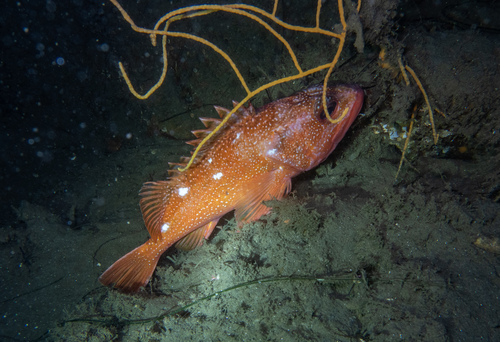
Starry Rockfish
Sebastes constellatus
Adorned with a galaxy of tiny white spots, the Starry Rockfish is a vibrant jewel of the Pacific's rocky reefs. This sedentary master of disguise brings the beauty of a night sky to the depths of the ocean floor.
Quick Identification
Size
Typically 30-38 cm (12-15 inches), reaching a maximum of 46 cm (18 inches) and weighing up to 1.4 kg (3 lbs).
Colors
Bright orange-red to pinkish body covered in hundreds of tiny white or yellowish spots; 3-5 large white blotches typically visible along the back.
Key Features
- Body densely covered in small white 'star-like' spots
- 3 to 5 distinct large white blotches along the base of the dorsal fin
- Vibrant orange-red primary body color
- Large eyes and a robust, spiny head typical of the rockfish family
When You’ll See Them
Geographic range
Where Does the Starry Rockfish Live?
The Starry Rockfish is native to the temperate waters of the Eastern Pacific Ocean. Its range primarily hugs the North American coastline, stretching from the chilly waters near San Francisco, California, all the way south to the central coast of Baja California, Mexico. They are particularly abundant in the Southern California Bight, where the complex underwater topography of the Channel Islands provides the perfect rocky sanctuary for them to thrive.
Basemap © OpenStreetMap contributors
Behavior
The Starry Rockfish is a quintessential 'sit-and-wait' predator of the Pacific reefs. Unlike many other fish that roam the open water, this species is highly sedentary and spends much of its life hovering just inches above rocky substrates or resting directly on ledges. They are solitary creatures, rarely forming schools, though they may share a particularly craggy reef with other rockfish species. Their calm demeanor makes them a favorite for underwater observers, as they often remain perfectly still even when approached.
These fish are territorial but not overly aggressive, relying on their intricate patterning to blend into the colorful sponge and anemone-covered rocks of their habitat. While they are most active during the day when they hunt for small prey, they are not known for long-distance travel, often spending their entire adult lives within a very small area of the seafloor. For humans, they are primarily encountered by deep-sea divers or seen via remote underwater cameras.
EverydayEarth exclusive
Camera Tips
Capturing a Starry Rockfish requires moving your camera exploration underwater. Because these fish live at significant depths, usually beyond the reach of casual 'backyard' setups, you will need a specialized waterproof housing or a tethered ROV (Remotely Operated Vehicle). The best placement is near high-relief structures—think large boulders, vertical rock walls, or deep-water pier pilings—where the fish can hide from larger predators like sea lions.
Lighting is the most critical factor for a clear shot. At the depths where Starry Rockfish reside, red light is the first to be filtered out by the water, making the fish appear grey or dull. To reveal their brilliant orange and 'starry' spots, use high-powered external video lights. Positioning your lights to the side of the camera rather than directly next to the lens will help reduce backscatter from floating plankton, resulting in a much crisper image.
Since these fish are relatively stationary, they are excellent subjects for time-lapse photography. Set your camera to trigger every 30 seconds to capture subtle movements and territorial displays. If you are using a drop-camera from a boat or pier, attaching a small bait cage filled with squid or sardines can help draw them out from their rocky crevices into the center of your frame. Be sure to use a weighted tripod or a heavy camera rig to prevent the Pacific currents from sweeping your gear away.
Similar Species
Species that look similar or are commonly confused with Starry Rockfish.
Frequently Asked Questions
Record Starry Rockfish at your habitat
Connect a camera to start building your own species record — AI identifies every visitor automatically.