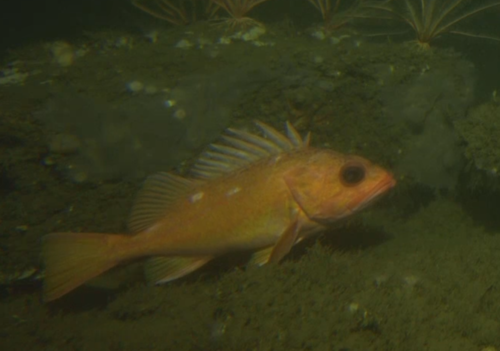
Greenspotted Rockfish
Sebastes chlorostictus
Adorned with shimmering emerald flecks, the Greenspotted Rockfish is a colorful sentinel of the Pacific's deep rocky reefs. This long-lived master of the deep-sea floor is a favorite sight for coastal explorers and underwater photographers alike.
Quick Identification
Size
Typically 25-40 cm (10-16 in) in length, reaching a maximum of 50 cm (20 in); weight usually ranges from 0.5-1.8 kg (1.1-4 lbs)
Colors
Bright yellowish-pink to orange-pink body with distinct small, bright green spots on the back and upper sides; three to five larger white spots often visible along the base of the dorsal fin
Key Features
- Distinctive small bright green spots on upper half of body
- Large, prominent eyes with a golden iris
- Three to five pale or white blotches along the dorsal midline
- Stout, sharp spines on the dorsal fin containing mild venom
When You’ll See Them
Geographic range
Where Does the Greenspotted Rockfish Live?
The Greenspotted Rockfish is native to the temperate waters of the Eastern Pacific Ocean. Its core range extends from the coastal waters of central Washington down through Oregon and California, reaching its southern limit near central Baja California, Mexico. This species thrives along the continental shelf and upper slope, favoring the rugged, cold-water environments typical of the California Current ecosystem.
Basemap © OpenStreetMap contributors
Behavior
The Greenspotted Rockfish is a master of the 'sit-and-wait' predatory style. These fish are primarily solitary and spend much of their time hovering just above or resting directly on the rocky seafloor. They are highly territorial regarding their specific crevice or boulder, rarely venturing far from their home range once they have reached adulthood. While they may appear sluggish, they are capable of lightning-fast bursts of speed to ambush passing prey.
Socially, they are less gregarious than other rockfish species, though they can occasionally be found in small, loose aggregations where food is particularly abundant. They have a long lifespan, often reaching 30 years or more. For humans, they are a prized catch for recreational anglers, though their slow growth and late maturity make them vulnerable to overfishing, requiring careful management by maritime authorities.
EverydayEarth exclusive
Camera Tips
Capturing the Greenspotted Rockfish requires specialized underwater equipment, as they reside far below the reach of standard backyard setups. For those utilizing underwater drop-cameras or ROVs (Remotely Operated Vehicles) near coastal reefs, the best strategy is to target 'high-relief' areas—underwater cliffs, large boulders, or sunken structures. Because these fish are bottom-dwellers, your camera should be angled slightly downward or horizontally just a few feet above the substrate to catch them in their natural resting state.
Artificial lighting is essential at the depths where these fish live. Use wide-angle video lights with a high CRI (Color Rendering Index) to bring out the brilliant green spots and pinkish hues that appear dull or grey in the blue-filtered natural light of the deep ocean. Slow, steady movements are key; while they are relatively bold, sudden mechanical noises or fast-moving shadows can cause them to retreat into deep rock crevices where they become nearly impossible to film.
If you are using a stationary baited camera trap, place a mesh bag of chopped squid or oily fish like mackerel near the lens. The scent will draw the Greenspotted Rockfish out of hiding. Position the camera so that the current carries the scent 'downstream' toward known rocky outcrops. Since they are active during both day and night, 24-hour monitoring is effective, but you will often see a spike in activity during the crepuscular hours when the change in light triggers their hunting instincts.
Similar Species
Species that look similar or are commonly confused with Greenspotted Rockfish.
Rosy Rockfish
Lacks the distinctive small green spots; has a more uniform reddish-pink body and often slightly smaller.
Starry Rockfish
Has numerous small white or yellowish-white spots (resembling stars) instead of green spots.
Swordspine Rockfish
Smaller in size with much longer, more prominent dorsal spines and fewer distinct spots.
Frequently Asked Questions
Record Greenspotted Rockfish at your habitat
Connect a camera to start building your own species record — AI identifies every visitor automatically.