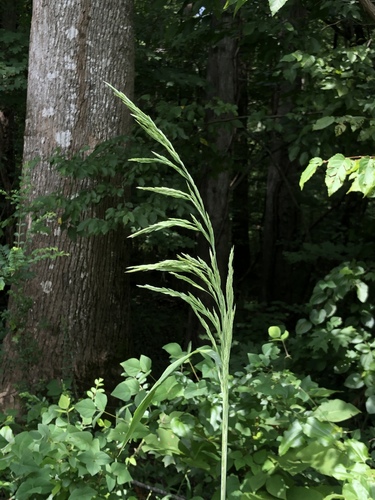
stout wood reed
Cinna arundinacea
Standing tall in the quiet damp of the forest, the stout wood reed is a master of the shaded wetland. Its silvery, drooping plumes add a touch of architectural elegance to the woodland floor.
Quick Identification
Size
Height: 3–6 feet (0.9–1.8 m); Leaf width: 0.25–0.75 inches (6–19 mm)
Colors
Soft gray-green to bluish-green foliage; silvery-green flower plumes that turn tan or straw-colored in autumn
Key Features
- Tall, unbranched stems reaching up to 6 feet
- Drooping, dense, silvery-green seed heads (panicles)
- Wide, sandpaper-textured leaf blades
- Prominent ligule at the leaf base
When You’ll See Them
Behavior
Stout wood reed is a resilient perennial grass that serves as a cornerstone of healthy wetland and floodplain ecosystems. Unlike many grasses that crave the scorching sun of open prairies, this species has evolved to thrive in the dappled light of the forest understory. It grows in elegant, tall clumps that provide essential structural depth to wooded areas, often forming loose colonies that sway gracefully in the slightest breeze.
While it doesn't move in the traditional sense, its presence indicates a high-quality habitat with consistent moisture. It acts as a natural filter for groundwater and provides essential nesting material and cover for various woodland creatures. For humans, it is an aesthetically pleasing, non-aggressive native plant that is frequently used in ecological restoration to stabilize soil in moist, shady zones where other grasses might fail.
EverydayEarth exclusive
Camera Tips
To capture the stout wood reed effectively, position your camera at a mid-to-high level, roughly 3 to 5 feet off the ground, to align with the large, drooping panicles. Because this is a stationary subject, the 'behavior' you are filming is its interaction with light and wind. If you are using a motion-activated trail camera, be aware that wind can trigger the sensors frequently; it is best to use a time-lapse mode or set the motion sensitivity to low to avoid filling your SD card with 'ghost' triggers of swaying grass.
Lighting is your most powerful tool for this species. Aim your camera lens toward the direction of the sunrise or sunset so that the golden hour light 'backlights' the silvery seed heads. This creates a stunning halo effect, making the plumes glow against the darker, shaded background of the woods. If you have a camera with adjustable shutter speeds, a faster setting will freeze the motion of the reed, while a slower setting can create a beautiful, ethereal blur as the grass moves.
Since stout wood reed is a natural food source for many creatures, use it as a 'focal point' for wildlife spotting. Position your camera to overlook a patch of these reeds near a water source. Songbirds and small mammals are often drawn to the seeds in the late fall and early winter. You don't need artificial lures; the standing seed heads are the lure. For a professional look, try to clear away distracting foreground debris so the camera can focus sharply on the textured culms and drooping plumes.
Similar Species
Species that look similar or are commonly confused with stout wood reed.
Drooping Woodreed
Cinna latifolia has even wider leaves and more widely spreading, drooping branches in its flower head.
Reed Canary Grass
An invasive species with much stiffer, more compact flower spikes that typically thrives in sunnier locations.
Rice Cutgrass
Has much rougher, 'saw-toothed' leaves that can actually cut skin, unlike the softer stout wood reed.
Frequently Asked Questions
Record stout wood reed at your habitat
Connect a camera to start building your own species record — AI identifies every visitor automatically.