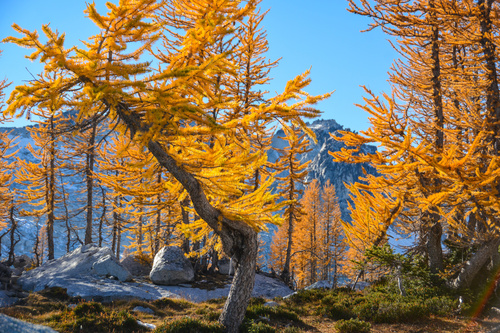
subalpine larch
Larix lyallii
A hardy sentinel of the high peaks, the subalpine larch is famous for its breathtaking autumn transformation into a pillar of gold. This long-lived deciduous conifer thrives where other trees fail, clinging to rocky ridges and braving the harshest alpine winters.
Quick Identification
Size
10-25 meters (33-82 feet) in height; trunk diameter up to 1 meter (3.3 feet)
Colors
Soft blue-green needles in spring/summer, turning brilliant golden-yellow in autumn; bark is thin and gray when young, becoming dark reddish-brown and deeply furrowed with age
Key Features
- Deciduous needles that turn bright gold and drop in autumn
- Grows at extreme high altitudes near the timberline
- Sparse, irregular crown with woolly, felt-like hair on new twigs
- Needles are 4-angled and grow in bundles of 30-40
When You’ll See Them
Behavior
The subalpine larch is a true survivor of the high peaks, often referred to as an 'extremophile.' Unlike most conifers that stay green year-round, this tree is deciduous, shedding its needles every winter to conserve energy and survive the crushing weight of mountain snow. It is one of the longest-lived trees in the world, with some specimens documented at over 1,000 years old. Because of the harsh conditions and short growing season at the timberline, these trees grow incredibly slowly, sometimes adding only an inch of girth over several decades.
In the ecosystem, the subalpine larch acts as a pioneer species, often being the first tree to colonize rocky, nutrient-poor slopes or areas cleared by avalanches. It provides essential cover for high-altitude wildlife like mountain goats, pikas, and Clark's nutcrackers. While it doesn't 'interact' with humans in a social sense, it is the star of the 'Larch March,' a seasonal phenomenon where hikers flock to the mountains to witness the trees' spectacular golden transformation before winter sets in.
EverydayEarth exclusive
Camera Tips
Capturing the subalpine larch on a trail or backyard camera requires a focus on landscape-style monitoring rather than traditional animal triggers. To document the stunning seasonal transition, set your camera to 'Time-Lapse' mode. Aim for one or two photos per day during late September and October. This allows you to create a video of the 'golden explosion' as the needles shift from green to yellow. Position the camera on a sturdy rock or a neighboring evergreen, as larches themselves are often found in windy, exposed areas where a standard tripod might tip.
Because the high-altitude sun is incredibly intense, use a polarizing filter if your camera housing allows for it to prevent the golden needles from looking 'washed out.' If you are looking to capture wildlife using the tree as a resource, place your camera about 2-3 feet off the ground facing the base of the trunk. Many small mammals, like pikas and marmots, forage around the roots, and Clark's nutcrackers often visit the upper branches to harvest seeds from the cones. If your camera has a 'Hybrid Mode' (photo + video), use it to catch the movement of the needles in the high mountain winds.
Exposure is key when photographing larches against snow or bright granite. If your camera has adjustable exposure compensation, set it to +0.5 or +1.0 when there is snow on the ground; otherwise, the tree will appear too dark. For those lucky enough to live near their habitat, a permanent weather-proof housing is recommended to capture the dramatic 'krummholz' effect—the stunted, twisted growth form these trees take on when battered by winter ice and wind.
Similar Species
Species that look similar or are commonly confused with subalpine larch.
Frequently Asked Questions
Record subalpine larch at your habitat
Connect a camera to start building your own species record — AI identifies every visitor automatically.