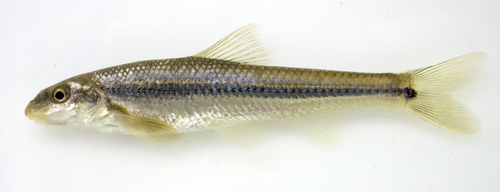
Suckermouth Minnow
Phenacobius mirabilis
A specialized master of the stream bed, the Suckermouth Minnow uses its unique anatomy to thrive in fast-moving currents where other fish struggle. With its striking lateral stripe and vacuum-like mouth, it is a fascinating subject for any backyard creek explorer.
Quick Identification
Size
Typically 2 to 4 inches (5 to 10 cm) in length; maximum size reaching approximately 5 inches (12.7 cm).
Colors
Olive-tan to silvery back with a prominent dark lateral stripe extending from the snout to the tail, ending in a distinct black spot.
Key Features
- Ventral, sucker-like mouth with fleshy lobes
- Slender, cylindrical body optimized for fast currents
- Dark lateral stripe ending in a small black spot at the tail base
- Horizontal orientation with a flat belly
When You’ll See Them
Geographic range
Where Does the Suckermouth Minnow Live?
Native to the North American continent, the Suckermouth Minnow is primarily found throughout the expansive Mississippi River basin. Its core range extends from the Appalachian foothills in West Virginia and Ohio westward to the Great Plains of Wyoming and Colorado. From north to south, it thrives from the southern tip of Minnesota through the Midwest into the river systems of Alabama and Oklahoma, with additional populations found in the western Lake Erie drainage.
Basemap © OpenStreetMap contributors
Behavior
The Suckermouth Minnow is a dedicated bottom-dweller, specifically adapted for life in the fast-moving sections of streams and rivers. Unlike many other minnows that swim in the middle of the water column, this species spends its time hugging the substrate. It uses its specialized, sucker-like mouth to probe cracks and crevices in gravel and sand, vacuuming up small invertebrates and organic matter. It is a hardy species that can tolerate higher turbidity (murky water) than many other sensitive minnows.
In terms of social patterns, they are generally found in small groups or as solitary individuals rather than forming massive, tight-knit schools. They are not known to be aggressive toward other species and often share riffle habitats with darters and other benthic fish. Their movement is characterized by short, quick darts from one rock to another, staying low to avoid the full force of the current and the eyes of aerial predators like kingfishers.
EverydayEarth exclusive
Camera Tips
To capture the Suckermouth Minnow on camera, you will need a waterproof action camera or a specialized underwater backyard observation system. The most effective placement is in the 'riffle' zones of a backyard creek—sections where the water is shallow, fast-moving, and breaks over rocks. Secure your camera to a heavy flat stone using a waterproof adhesive mount or a weighted tripod, ensuring the lens is positioned just 2 to 3 inches above the stream bed. Angling the camera slightly downstream is often more effective than facing it directly into the current, as it captures the fish as they swim upward to forage.
While you can't easily 'bait' a minnow in the traditional sense, you can encourage them to visit your camera's field of view by creating a localized feeding opportunity. Gently disturb the gravel or turn over a few medium-sized rocks about two feet upstream from your camera. This releases 'drift'—small insect larvae and nutrients—into the current. The Suckermouth Minnow's natural instinct is to move toward these disturbed areas to catch the easy meals floating by. This technique is highly effective for getting them to hold still in front of the lens.
Water clarity is your biggest challenge. For the best AI-powered detection and clear footage, wait for 48 to 72 hours after a rainstorm so the silt can settle. Use a high frame rate (at least 60fps) if your camera allows, as these fish move with sudden, jerky motions that can appear blurry on standard settings. Mid-day sun is actually beneficial for underwater filming as it provides the necessary light penetration to highlight the subtle olive and silver scales on the fish's back.
Similar Species
Species that look similar or are commonly confused with Suckermouth Minnow.
Central Stoneroller
The Stoneroller has a more blunt head and a hard, ridge-like lower lip used for scraping algae, unlike the fleshy sucker-mouth of the minnow.
Bigeye Chub
The Bigeye Chub has significantly larger eyes relative to its head size and lacks the specialized sucker-like mouth structure.
Frequently Asked Questions
Record Suckermouth Minnow at your habitat
Connect a camera to start building your own species record — AI identifies every visitor automatically.