Swallow Tanager
Tersina viridis
A shimmering jewel of the South American canopy, the Swallow Tanager captivates with its brilliant turquoise plumage and unique burrow-nesting habits. Whether they are sallying for insects or feasting on garden fruits, these social birds are a spectacular sight for any backyard observer.
Quick Identification
Size
Length: 14-15 cm (5.5-6 in); Weight: 25-36 g (0.9-1.3 oz)
Colors
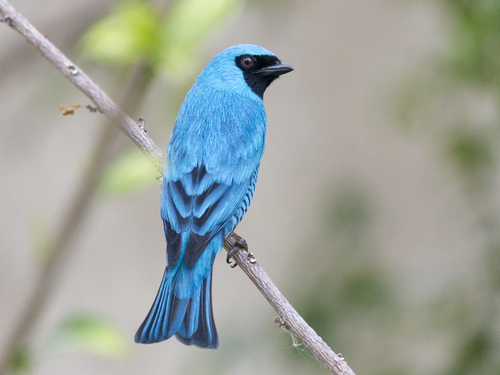
Males are a brilliant, shimmering turquoise blue with a black face and throat; females are a bright lime-green with yellow-green underparts. Both sexes feature distinct dark barring on the flanks.
Key Features
- Broad, flattened bill resembling a swallow's
- Deep black facial mask (males)
- Heavy horizontal barring on the belly and sides
- Vibrant turquoise or lime-green plumage
When You’ll See Them
Behavior
The Swallow Tanager is a highly social and unique member of the tanager family, often seen in small groups or mixed-species flocks. Unlike many of its relatives, it has a distinct habit of nesting in burrows, which they may excavate themselves in earthen banks or find in crevices in walls and tree cavities. This ground-to-canopy lifestyle makes them fascinating to watch as they move between high fruit-bearing trees and lower nesting sites.
These birds are exceptionally agile in the air. While they are primarily fruit-eaters, they possess a wide, swallow-like gape that allows them to snap up insects mid-flight with impressive precision. In a backyard setting, they are generally peaceful and will readily visit fruit feeders, though they tend to remain wary of high-traffic areas, preferring the safety of nearby foliage between feedings.
EverydayEarth exclusive
Camera Tips
To capture the stunning iridescent blue of a male Swallow Tanager, camera placement is everything. These birds are canopy lovers but will descend for water and food. Position your AI-powered camera near fruiting trees like Cecropia, Ficus, or berry-producing shrubs. If you are using a feeder, choose a spot that receives dappled morning sunlight; direct midday sun can blow out the highlights on their reflective feathers, while too much shade makes the blue look dull or black. Angle the camera slightly downward from a height of 5 to 7 feet to catch the bird as it perches on lower branches before approaching food.
If you live in an area where they nest, look for vertical earthen banks or even stone retaining walls with small cavities. Placing a camera near these potential nesting sites can yield incredible footage of their unique burrowing behavior. However, keep the camera at a respectful distance (at least 10 feet) and use a zoom setting if available to avoid disturbing the pair. During the breeding season, they become more territorial and predictable in their flight paths, making it easier to time your captures.
For baiting, these birds are particularly fond of halved bananas or papayas placed on a platform feeder. Because they are also aerial insectivores, having a water feature like a birdbath with a dripper or small fountain is a massive draw. The movement of the water catches their eye from the canopy. Set your camera to a high shutter speed or 'Sports Mode' if available, as their movements are quick and darting. Since they often travel in pairs or small groups, use a wider field of view to capture the social interactions between the turquoise males and the bright green females.
Similar Species
Species that look similar or are commonly confused with Swallow Tanager.
Blue-necked Tanager
Has a primarily black body and golden wings, unlike the all-turquoise body of the male Swallow Tanager.
Green Honeycreeper
Smaller with a much longer, curved bill and lacks the heavy flank barring seen on Swallow Tanagers.
Blue Dacnis
Deep blue rather than turquoise, with a black back and a much pointier, thinner beak.
Frequently Asked Questions
Record Swallow Tanager at your habitat
Connect a camera to start building your own species record — AI identifies every visitor automatically.