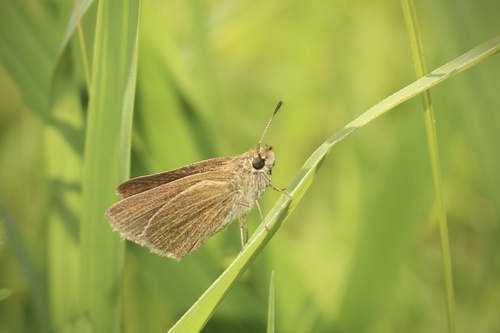
Swarthy Skipper
Nastra lherminier
The understated ghost of the meadow, the Swarthy Skipper is a delight for those who appreciate the subtle details of nature. This tiny, olive-brown butterfly is a master of camouflage in the tall grass.
Quick Identification
Size
Wingspan of 22–30 mm (0.87–1.2 inches)
Colors
Uniformly drab brownish-gray to olive-brown; usually lacks distinct spots, though some individuals show faint, pale marks on the forewings.
Key Features
- Plain, unmarked brownish-olive wings
- Small, rounded wing shape typical of grass skippers
- Short, stubby antennae with hooked clubs
- Low, jerky flight pattern close to the ground
When You’ll See Them
Behavior
Unlike many butterflies that bask with wide-open wings, the Swarthy Skipper frequently rests in the 'jet plane' position—a signature of the skipper family where the forewings are held at a 45-degree angle while the hindwings are spread flat. They are solitary creatures but are highly localized; if you see one, there is a good chance a colony is established nearby in a patch of native grass.
EverydayEarth exclusive
Camera Tips
Capturing a Swarthy Skipper on a backyard or trail camera requires a specialized approach due to their small size and 'stealth' coloring. For the best results, use a camera with a macro lens or a dedicated close-focusing trigger. Since these butterflies rarely fly higher than two or three feet off the ground, mount your camera on a low tripod or a ground stake. Aim the lens at a patch of flowering nectar plants like White Clover or Wild Strawberry, as these are the primary 'hotspots' where the skipper will pause long enough for a clear shot.
Lighting is your best friend when filming this drab-colored insect. To reveal the subtle olive hues and soft textures of its wings, position your camera so the sun is behind it or to the side (side-lighting). This creates shadows that define the wing veins and body shape, preventing the insect from looking like a flat brown smudge. Avoid deep shade, as the Swarthy Skipper will simply vanish into the dark background. A high-shutter speed or high-frame-rate setting is essential to freeze their rapid wing beats during takeoff and landing.
To lure them into your camera’s frame, consider a 'pollinator station' strategy. Plant native grasses like Little Bluestem—the primary host plant for their caterpillars—near a cluster of nectar-rich flowers. If you are using an AI-powered camera, set the sensitivity to high and the capture zone to a tight 12-to-18-inch radius around a specific flower head. In mid-summer, look for them during the peak heat of the day when they are most active. If your camera allows for manual focus, pre-focus on the center of a flower to ensure the skipper's tiny body is crisp and sharp when it lands.
Similar Species
Species that look similar or are commonly confused with Swarthy Skipper.
Frequently Asked Questions
Record Swarthy Skipper at your habitat
Connect a camera to start building your own species record — AI identifies every visitor automatically.