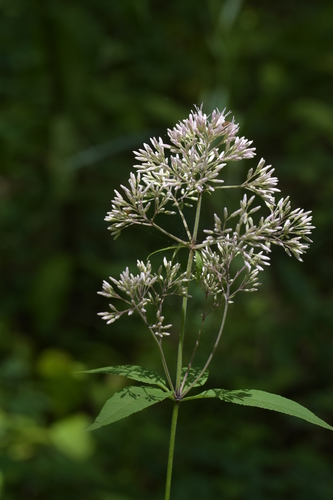
sweet Joe-Pye-weed
Eutrochium purpureum
A towering monarch of the late-summer garden, Sweet Joe-Pye-weed is a nectar-rich skyscraper that attracts clouds of butterflies with its vanilla-scented, dusty-rose blooms.
Quick Identification
Size
Stands 3 to 7 feet (0.9 to 2.1 meters) tall with a spread of 2 to 4 feet (0.6 to 1.2 meters)
Colors
Dusty rose to pale purple flower clusters; deep green foliage; stems are mostly green with purple color concentrated at the leaf nodes
Key Features
- Domed clusters of tiny, fuzzy pale pink flowers
- Whorls of 3 to 4 lance-shaped leaves around the stem
- Solid green stems with purple only at the leaf joints
- Distinct vanilla scent when leaves are crushed or in full bloom
When You’ll See Them
Behavior
Sweet Joe-Pye-weed is a stately perennial that serves as a cornerstone of the late-summer garden. Unlike its cousins that prefer soaking wet marshes, this species is often found in dappled sunlight along the edges of forests or in rich, moist thickets. It grows with a distinct architectural uprightness, topped by large, billowy flower heads that can reach nearly a foot across. It is a slow-stretching plant, emerging late in the spring but rapidly gaining height as the heat of summer arrives.
Ecologically, this plant acts as a massive social hub for the local insect population. It is one of the most prolific nectar producers in the Eastern United States, often hosting a dozen different species of butterflies, bees, and wasps simultaneously on a single flower head. While it is a robust grower, it is not aggressive or invasive, making it a peaceful neighbor for other native woodland plants. It interacts with humans primarily as a sensory delight; its faint vanilla aroma on a humid August afternoon is one of the hallmarks of a healthy backyard ecosystem.
EverydayEarth exclusive
Camera Tips
Capturing the beauty of Sweet Joe-Pye-weed requires a strategy that accounts for both the plant's height and the high-speed action of its visitors. Because these plants can grow up to 7 feet tall, you should mount your camera on a tall tripod or a fence post to get eye-level with the flower heads. Avoid pointing the camera downward, as you’ll miss the profile of visiting butterflies. Aim for a side-on or slightly upward angle to capture the 'fuzzy' texture of the florets against the sky or a soft green background.
Since the primary reason to put a camera on Sweet Joe-Pye-weed is to catch pollinators, use your camera’s 'Burst' or 'Pro-Capture' mode. Swallowtail butterflies and clearwing moths move their wings rapidly, so a fast shutter speed is essential to freeze the action. If you are using a motion-triggered trail camera, ensure it is set to its highest sensitivity and placed within 3 to 5 feet of the flower cluster. Many AI cameras can be trained to recognize the specific flight patterns of bees or butterflies that frequent these blooms.
Lighting is your best friend with this species. The dusty rose color of the flowers can look muddy in flat, midday light. Try to position your camera so the morning or late afternoon sun 'backlights' the flower heads. This makes the fine hairs of the flowers glow and creates a beautiful halo effect around the wings of visiting insects. If your garden is windy, use a garden stake to subtly secure the main stem of the plant just out of the camera's frame; this prevents the motion sensor from being triggered by the plant swaying and ensures your focus remains sharp on the flower head.
Similar Species
Species that look similar or are commonly confused with sweet Joe-Pye-weed.
Frequently Asked Questions
Record sweet Joe-Pye-weed at your habitat
Connect a camera to start building your own species record — AI identifies every visitor automatically.