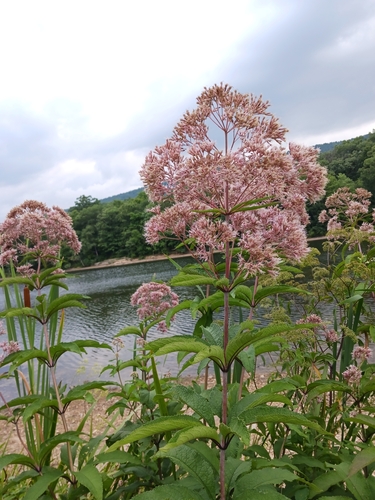
Hollow Joe-Pye Weed
Eutrochium fistulosum
A towering giant of the late-summer meadow, Hollow Joe-Pye Weed is a skyscraper for pollinators, offering massive dusty-rose blooms that attract everything from Monarchs to hummingbirds.
Quick Identification
Size
Height: 1.5–3 meters (5–10 feet); Spread: 0.6–1.2 meters (2–4 feet)
Colors
Dusty rose to pale purple flower clusters; stems are dark purple or green with purple mottling and a waxy white bloom
Key Features
- Tall, hollow stems often covered in a waxy coating
- Leaves arranged in whorls of 4 to 7 at each node
- Large, domed clusters of tiny, vanilla-scented pinkish-purple flowers
- Serrated, lance-shaped leaves up to 10 inches long
When You’ll See Them
Behavior
Hollow Joe-Pye Weed is a perennial powerhouse that acts as a social hub for the late-summer garden. While it stands still, it is a hive of activity, often swaying gently in the breeze due to its immense height. It begins its growth spurt in late spring, rapidly reaching for the sky to tower over competing vegetation in moist meadows and roadside ditches.
As a late-season bloomer, it provides a critical service to migrating insects. Its large, flat-topped flower heads are perfectly designed for heavy-bodied butterflies and bees to land on and navigate easily. Unlike many garden plants that have been bred for aesthetics over nectar, this native species is a reliable high-calorie fuel station for the ecosystem. It is remarkably sturdy for its height, though its hollow stems can occasionally lean after heavy summer thunderstorms.
EverydayEarth exclusive
Camera Tips
Capturing the beauty of Hollow Joe-Pye Weed requires a different approach than fast-moving mammals. Because this plant can reach 10 feet, you should mount your camera at a slight upward angle on a fence post or tripod to capture the majesty of its towering stems against the sky. For the most dramatic colors, aim for the 'golden hour'—the hour after sunrise or before sunset—when the low light hits the waxy, purple stems and makes the dusty-pink blooms glow.
If your goal is to use an AI-powered camera to identify visitors, focus your lens on a single large flower cluster about 5–6 feet off the ground. Set your trigger speed to the highest sensitivity; while the plant doesn't move, the butterflies and clearwing moths that visit it are incredibly fast. A 'burst mode' setting is ideal here, as it allows you to capture the exact moment a Swallowtail or Monarch spreads its wings while feeding on the nectar.
For a unique perspective, consider a time-lapse setting during the peak of August. Setting your camera to take one photo every hour for a week will showcase the 'sleep movements' of the leaves and the rapid expansion of the flower buds. If your camera has macro capabilities, get as close as 12 inches to a flower head. The individual disk florets are fascinatingly complex and make for stunning high-definition captures that most casual observers never see.
Don't stop recording once the flowers fade. In late autumn, the seed heads turn a beautiful fuzzy bronze. This is a prime time to catch late-season birds like Goldfinches landing on the stalks to eat the seeds. Ensure your camera is secured tightly, as these birds can cause the tall stalks to bounce, which may trigger motion sensors or cause motion blur if the shutter speed is too low.
Similar Species
Species that look similar or are commonly confused with Hollow Joe-Pye Weed.
Spotted Joe-Pye Weed
Has solid stems with purple spots and flatter flower clusters compared to the domed clusters of the hollow variety.
Sweet Joe-Pye Weed
Features green stems that are only purple at the leaf joints and flowers that give off a faint vanilla scent.
Boneset
A relative with similar fuzzy clusters but they are bright white, and the leaves appear to be pierced by the stem.
Frequently Asked Questions
Record Hollow Joe-Pye Weed at your habitat
Connect a camera to start building your own species record — AI identifies every visitor automatically.