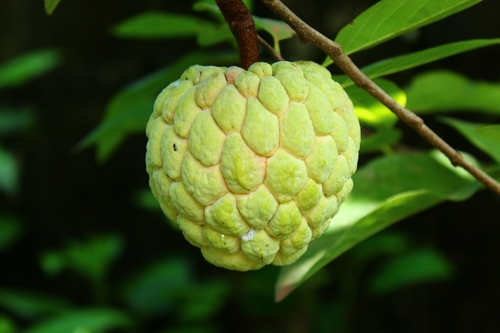
Sweetsop
Annona squamosa
Meet the Sweetsop, the 'Sugar Apple' of the tropics that turns any backyard into a lush, wildlife-friendly oasis. With its unique knobby fruit and custard-like center, this tree is as beautiful to look at as it is delicious to encounter.
Quick Identification
Size
Height of 3-8 meters (10-26 feet); fruit 6-10 cm (2.4-3.9 inches) in diameter
Colors
Light green to blue-green fruit with a white powdery bloom; light brown or grey bark; dull green leaves
Key Features
- Heart-shaped or spherical fruit with distinct knobby, scale-like segments
- Fragrant, yellowish-green flowers with three fleshy outer petals
- Thin, grey-brown bark with shallow fissures and inner light-yellow wood
- Leaves are oblong and emit a distinct scent when crushed
When You’ll See Them
Loading activity data...
Behavior
The Sweetsop, or Sugar Apple, is a resilient and fast-growing deciduous tree that thrives in tropical lowland environments. Unlike its relatives the Cherimoya or Soursop, the Sweetsop is highly tolerant of heat and dry spells, making it a favorite for backyard gardeners in warmer climates. It follows a seasonal cycle where it may shed its leaves during the dry season to conserve moisture before bursting into new growth and blooming when the rains arrive.
As a key player in the backyard ecosystem, the Sweetsop has a fascinating relationship with its pollinators. It is primarily pollinated by nitidulid beetles, which are attracted to the heavy, sweet scent of the flowers. For humans, the tree is a source of joy; its fruit is prized for its creamy, custard-like white pulp that tastes like a blend of pineapple and vanilla. However, the seeds are hard and indigestible, serving as a reminder of the plant's strategy for dispersal via larger wildlife.
EverydayEarth exclusive
Camera Tips
To capture the full life cycle of a Sweetsop on your EverydayEarth camera, focus your lens on a cluster of developing fruit rather than the trunk. Setting your camera to a time-lapse mode is the best way to watch the fascinating transition from the small, green flower buds to the heavy, knobby fruits. I recommend taking one shot every four hours; this will allow you to see the fruit segments swell and the skin develop that characteristic white powdery bloom, known as 'glaucous' coating.
Since the Sweetsop is a major attraction for backyard wildlife, position a secondary camera about 5 to 6 feet high on a nearby branch or pole, angled slightly downward toward a ripening fruit cluster. This setup is perfect for catching fruit-eating birds like bulbuls or orioles during the day. If you live in a region with fruit bats, ensure your camera's infrared (IR) sensors are active at night. Bats are highly attracted to the scent of ripening Sweetsop and provide some of the most dramatic night-time footage as they hover to take bites of the soft pulp.
If you are interested in the micro-wildlife, use a macro lens attachment or a close-focus setting on your AI camera to monitor the flowers. The best time to catch the pollinating beetles in action is in the early morning hours, between 6:00 AM and 9:00 AM, when the flowers first open and release their fragrance. Look for small, dark beetles crawling inside the fleshy petals.
Seasonal timing is everything. Start your monitoring in late spring to catch the flowering phase, and increase your camera's trigger sensitivity in late summer as the fruit reaches maturity. Be sure to wipe your camera lens frequently; the Sweetsop tree can sometimes produce sticky sap or attract ants that might obscure the view. If you are using a trail camera with a motion sensor, set the 're-trigger' interval to short (around 15-30 seconds) to ensure you capture the entire visit of a feeding animal rather than just a single snapshot.
Similar Species
Species that look similar or are commonly confused with Sweetsop.
Soursop
Much larger fruit with a prickly skin and a tart, citrus-like flavor compared to the sweet, knobby Sweetsop.
Cherimoya
The skin is smoother with fingerprint-like depressions rather than the distinct protruding knobs found on the Sweetsop.
Custard Apple
Often refers to Annona reticulata, which has a smoother, reddish-brown skin and a less segmented appearance.
Frequently Asked Questions
Record Sweetsop at your habitat
Connect a camera to start building your own species record — AI identifies every visitor automatically.