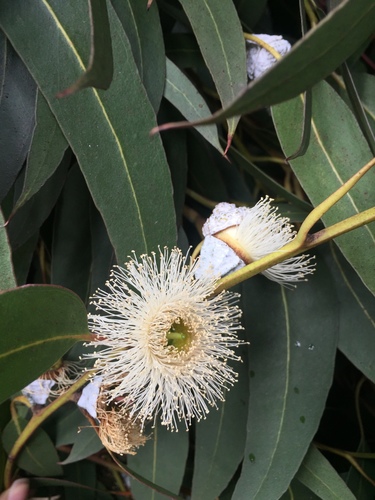
Tasmanian blue gum
Eucalyptus globulus
The Tasmanian blue gum is a sky-piercing icon of the Australian bush, known for its silver-blue juvenile leaves and its role as a vital nectar source for a dizzying array of wildlife.
Quick Identification
Size
Typically 30–55 m (98–180 ft) tall, though exceptional specimens can reach 90 m (295 ft); trunk diameter 1–2 m (3.3–6.6 ft)
Colors
Smooth mottled bark in shades of cream, grey, and copper; silvery-blue juvenile leaves; glossy dark green adult leaves; creamy-white flowers
Key Features
- Bark sheds in long, ribbon-like strips
- Juvenile leaves are waxy, silvery-blue, and grow in opposite pairs
- Adult leaves are thick, glossy, and sickle-shaped
- Large, woody, four-ribbed seed capsules
When You’ll See Them
Geographic range
Where Does the Tasmanian blue gum Live?
Native to the cool, temperate regions of southeastern Australia, the Tasmanian blue gum finds its primary home in the island state of Tasmania and the southern coastal regions of Victoria. Because of its incredible growth rate and versatile timber, it has been introduced to nearly every continent. You will now find thriving populations across the Mediterranean basin, the western coast of the United States (particularly California), and throughout parts of South Africa and South America.
Basemap © OpenStreetMap contributors
Behavior
The Tasmanian blue gum is a fast-growing evergreen giant that plays a foundational role in its ecosystem. It is a 'pioneer' species, often being one of the first to recolonize areas after a disturbance. These trees are famous for their high oil content; the leaves are filled with volatile eucalyptus oil, which creates the distinctive blue haze seen over eucalyptus forests on hot days. This oil serves as a defense against many herbivores, though it also makes the trees highly flammable, a trait that helps clear out competing vegetation and triggers seed release after a fire.
In a backyard or park setting, these trees are massive biological hubs. They provide essential nectar for birds and insects during their winter flowering period when other food sources are scarce. While they are solitary giants in many landscapes, they interact with humans primarily through their shade and the debris they drop—including 'ribbons' of bark and woody seed pods. In many parts of the world where they've been introduced, such as California, they are both beloved for their aesthetics and monitored closely for their impact on local water tables and fire safety.
EverydayEarth exclusive
Camera Tips
To capture the majesty of a Tasmanian blue gum, you should focus on the life it attracts. Place your AI-powered camera on a nearby structure or a smaller tree, angled upward toward the lower canopy or the main trunk. These trees are 'supermarkets' for wildlife; positioning your camera to overlook a cluster of flowering buds during the winter months is a surefire way to record nectar-feeding birds, such as honeyeaters or parrots, and various pollinating insects.
Because the bark of the blue gum sheds in long, dramatic ribbons, these trees make excellent subjects for time-lapse photography. Set your camera to take a photo once a day over several months to witness the mottled trunk transform as the old bark peels away to reveal the smooth, colorful new layer underneath. This shedding process often exposes small hollows or crevices where insects and spiders hide, which in turn attracts insectivorous birds.
If you are looking for larger visitors, place the camera at the base of the tree facing upward. In their native Australia, this can help you spot koalas climbing the trunk, while in North America or Europe, you might capture owls using the high branches as hunting perches or squirrels navigating the canopy. Use a wide-angle setting if available, as the scale of these trees can easily overwhelm a narrow field of view. Ensure your camera is secured tightly, as the smooth bark offers little grip and the tree can sway significantly in high winds.
Similar Species
Species that look similar or are commonly confused with Tasmanian blue gum.
Frequently Asked Questions
Record Tasmanian blue gum at your habitat
Connect a camera to start building your own species record — AI identifies every visitor automatically.