Tasselled Wobbegong
Eucrossorhinus dasypogon
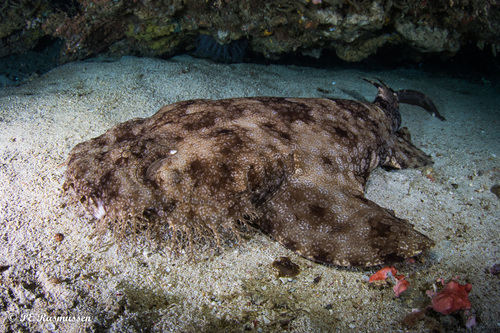
The ultimate master of disguise, the Tasselled Wobbegong is a carpet shark that blends perfectly into the coral reef. With its ornate 'beard' and mosaic patterns, it remains invisible until the moment it strikes.
Quick Identification
Size
Reaches a maximum length of approximately 1.8 meters (5.9 feet), featuring a wide, heavily flattened body.
Colors
Complex mosaic of brown, tan, and cream-colored blotches with dark reticulated lines; camouflage mimics coral and algae-covered rock.
Key Features
- Extensive fringe of branching dermal flaps (tassels) around the head and chin
- Broad, extremely flattened head and pectoral fins
- Intricate, rug-like camouflage pattern across the entire dorsal surface
- Two dorsal fins set far back on the body near the tail
When You’ll See Them
Behavior
The Tasselled Wobbegong is the undisputed master of ambush within the reef ecosystem. Unlike many shark species that must remain in constant motion to breathe, this carpet shark is a sedentary bottom-dweller that spends its daylight hours resting in caves or under coral overhangs. They are highly site-attached, meaning they often return to the same 'home' crevice every day, making them a predictable sight for those who know where to look.
By night, they become stealthy predators. They rely entirely on their incredible camouflage to stay invisible to both prey and threats. When a fish or crustacean wanders too close to its mouth, the wobbegong uses a powerful suction mechanism—expanding its oropharyngeal cavity to literally 'hoover' the prey into its needle-like teeth. While generally non-aggressive toward humans, they have a strong 'bite and hold' reflex if stepped on or cornered, so they should always be observed from a respectful distance.
EverydayEarth exclusive
Camera Tips
Capturing high-quality footage of a Tasselled Wobbegong requires specialized underwater equipment, as these sharks are strictly marine. If you live in a coastal area near northern Australia or New Guinea, your 'backyard' might include a reef where these sharks reside. For the best results, use an underwater trail camera or an action camera in a waterproof housing equipped with a large capacity memory card and an external battery pack. Because these sharks are remarkably sedentary during the day, they are the perfect subjects for long-exposure time-lapse photography or stationary video sets.
Placement is critical: look for 'ledge' habitats or small limestone caves during the day. Once you find a resting wobbegong, position your camera on a weighted tripod roughly 3 to 5 feet away from the shark's head, aiming at a 45-degree angle. This angle is essential to capture the unique 'tassels' around the jawline, which are the shark's most defining feature. Avoid placing the camera directly in the shark's face, as this can cause them to retreat further into the reef. If you are deploying the camera overnight, ensure you have a diffuse, low-intensity red or warm-white light source; bright, direct white lights can startle the shark and wash out its intricate skin patterns.
For those looking to capture hunting behavior, set your camera's motion trigger to its highest sensitivity or use a continuous time-lapse mode (one frame every 5-10 seconds). Wobbegongs are famous for their 'tail-waving' lure behavior, where they twitch the end of their tail to mimic a small fish to draw in prey. Placing your camera near the tail end of the shark can capture this fascinating biological trick. Always ensure your camera housing is securely weighted or tethered to a non-living substrate (like a rock or dead coral) to prevent it from being moved by the tide or curious sea turtles.
Similar Species
Species that look similar or are commonly confused with Tasselled Wobbegong.
Frequently Asked Questions
Record Tasselled Wobbegong at your habitat
Connect a camera to start building your own species record — AI identifies every visitor automatically.