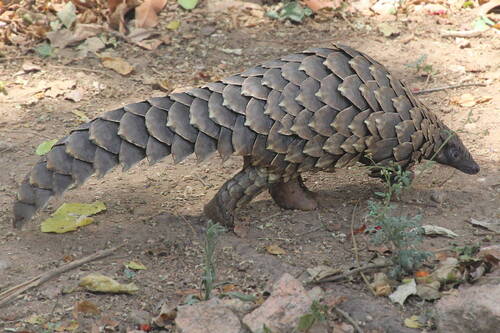
Temminck's Ground Pangolin
Smutsia temminckii
Meet the world's most armored mammal, a prehistoric wonder that walks on its hind legs and wears a suit of scales. The Temminck's Ground Pangolin is a rare, gentle guardian of the African grasslands.
Quick Identification
Size
Total length 70–120 cm (27–47 in); weight 7–18 kg (15–40 lbs)
Colors
Scales range from dark brown to olive-grey or yellowish-brown; skin on the belly and face is pale pinkish-grey.
Key Features
- Body covered in large, overlapping keratin scales
- Often walks bipedally on hind legs with front claws tucked
- Small, pointed head without external ears
- Thick, heavy tail used for balance and defense
When You’ll See Them
Behavior
Temminck's Ground Pangolin is a solitary and primarily nocturnal creature, though it may occasionally emerge during the day in cooler winter months to conserve energy. They are famously shy and elusive, spending their daylight hours hidden in deep burrows usually stolen from aardvarks or porcupines. When they move, they often exhibit a unique bipedal gait, balancing on their heavy hind legs and using their tail as a counterweight while tucking their sharp digging claws into their chests.
These mammals are the ultimate specialists, having evolved a defense mechanism that makes them nearly untouchable by predators like lions or leopards. When threatened, they roll into a tight, impenetrable ball, protecting their soft underbelly and exposing only their sharp-edged scales. Because they lack teeth, they rely entirely on their powerful sense of smell to locate prey and a tongue that can be longer than their body to hunt.
In terms of social structure, they are largely independent, only coming together briefly for mating. They are highly sensitive to human encroachment and habitat change, making them a rare sight even in areas where they are known to reside. Observing one in the wild is considered a once-in-a-lifetime event for many wildlife enthusiasts.
EverydayEarth exclusive
Camera Tips
Capturing a Temminck's Ground Pangolin on camera requires immense patience and strategic placement. Because they are low-slung animals, your camera should be mounted no higher than 30–50 cm (12–20 inches) off the ground. Angle the lens slightly upward if you are placing it near the base of a known termite mound or an active burrow entrance. These animals have an incredible sense of smell, so avoid wearing strong perfumes or leaving human scent on the camera casing during setup.
The best locations for your camera are along established 'game trails' or near water holes during the dry season. Unlike many other mammals, pangolins do not have a fixed 'home' burrow every night, but they do frequent the same foraging paths. Look for their distinct tracks—a central drag mark from the tail flanked by staggered hind-foot prints. If you find a termite mound with fresh excavations, that is a prime spot for a 48-hour soak.
Regarding settings, use a high-sensitivity PIR (passive infrared) sensor setting. Pangolins move slowly and deliberately, but their scales don't always radiate high levels of heat compared to furry mammals, which can occasionally fail to trigger lower-end cameras. Video mode is highly recommended; 20-second clips will allow you to see their fascinating bipedal movement, which a still photo often fails to capture effectively.
Avoid using white-flash cameras as the sudden burst of light can spook these sensitive creatures. Instead, opt for 'No-Glow' or black infrared LEDs. Since they are most active in the dead of night, ensure your camera has a strong infrared range. In the winter, try checking your cameras earlier in the evening, as they may shift their activity to the late afternoon (crepuscular) to avoid the freezing midnight temperatures of the African bush.
Similar Species
Species that look similar or are commonly confused with Temminck's Ground Pangolin.
Aardvark
Aardvarks have large, rabbit-like ears and thick skin with sparse hair, whereas the pangolin is covered in scales and has no visible external ears.
Giant Ground Pangolin
Much larger than the Temminck's, this species is found in the moist jungles and savannas of West and Central Africa, not the southern/eastern regions.
Cape Porcupine
Often sharing the same burrows, porcupines are identified by their long, sharp quills rather than the flat, overlapping scales of a pangolin.
Frequently Asked Questions
Record Temminck's Ground Pangolin at your habitat
Connect a camera to start building your own species record — AI identifies every visitor automatically.