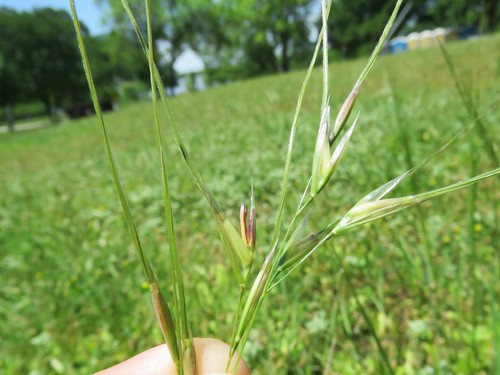
Texas winter grass
Nassella leucotricha
A hardy survivor that paints the landscape green when all else is dormant, Texas wintergrass is the backbone of the southern winter prairie. Its unique 'self-planting' seeds and importance to local wildlife make it a fascinating species to track in your own backyard.
Quick Identification
Size
Stems reach 12 to 40 inches (30–100 cm) in height; seed awns are 2.5 to 4 inches long.
Colors
Rich green foliage in winter; straw-colored seed heads; seeds feature a distinct ring of white hairs at the base.
Key Features
- Long, needle-like awns that twist when dry
- Distinctive collar of white hairs at the base of the seed
- Bunchgrass growth habit with deep green winter leaves
- Sharp, spear-like seeds designed to 'drill' into soil
When You’ll See Them
Loading activity data...
Behavior
Texas wintergrass is a resilient cool-season perennial that earns its name by staying vibrant and green throughout the winter months when most other southern grasses go dormant. It grows in distinctive clumps or tussocks, providing essential structural diversity to a backyard meadow or prairie. While it may look like a typical lawn grass from a distance, its life cycle is unique: it produces two types of seeds, including one set hidden at the base of the leaves to ensure survival even if the tall stalks are grazed or mowed.
This grass plays a vital role in the local ecosystem by providing one of the few sources of green forage for deer and rabbits during the coldest parts of the year. In the spring, it transforms into a sea of waving 'needles' as the long, twisted awns develop. These awns are hygroscopic, meaning they twist and untwist as humidity changes, a fascinating mechanical behavior that literally screws the seed into the ground or hitches a ride on the fur of a passing animal.
EverydayEarth exclusive
Camera Tips
To capture the beauty and utility of Texas wintergrass, place your camera at a low 'critter-eye' level, roughly 10 to 15 inches off the ground. This perspective allows you to see both the architectural structure of the grass and the various animals that use it for cover. Because this grass stays green in winter, it acts as a natural magnet for wildlife; aim your camera at a healthy clump during January or February to catch deer, rabbits, and even armadillos foraging in the green patch.
If you are looking to document the plant's fascinating seeding process, use a time-lapse setting during the months of April and May. Set the interval to capture one photo every 30 minutes. When played back, you will see the seed heads emerge and the long awns react to the morning dew and afternoon sun. For the best visual results, position the camera so the grass is back-lit by the morning sun, which will make the white hairs and long awns glow against a darker background.
Be aware that the height of the seed stalks can cause 'false triggers' on motion-sensitive cameras during windy days. To mitigate this, lower the sensitivity of your PIR sensor or use the 'detection zone' feature to exclude the very top of the frame where the grass waves most aggressively. Focus your trigger zone on the base of the plant where ground-nesting birds like sparrows or towhees will spend time scratching for fallen seeds.
Lastly, consider the seasonal transition. In late spring, the seeds become very sharp and mobile. If you are mounting your camera on a post near the grass, check the lens periodically, as the twisting awns have a way of 'walking' their way into every crevice, including camera seals or over the lens itself. A quick wipe-down and a check for stray seeds will keep your footage clear during the peak seeding season.
Similar Species
Species that look similar or are commonly confused with Texas winter grass.
Purple Threeawn
Purple threeawn has seeds with three distinct hair-like branches (awns) rather than just one single long awn.
Little Bluestem
Little bluestem turns a striking reddish-tan in winter, whereas Texas wintergrass remains bright green.
Canada Wildrye
Wildrye has thicker, bristly seed heads that resemble wheat, lacking the single needle-like awn of wintergrass.
Frequently Asked Questions
Record Texas winter grass at your habitat
Connect a camera to start building your own species record — AI identifies every visitor automatically.