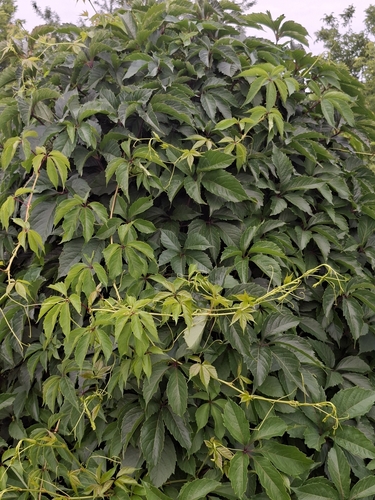
thicket creeper
Parthenocissus inserta
A hardy and vibrant native climber, the thicket creeper is a master of camouflage and a cornerstone of backyard biodiversity. Known for its brilliant autumn transformation, it provides essential food and shelter for a wide array of birds and pollinators.
Quick Identification
Size
Vine length of 10–20 meters (33–66 feet); individual leaflets are 5–12 cm (2–5 inches) long.
Colors
Glossy green foliage in summer; brilliant scarlet to deep burgundy in autumn; dark blue-black berries; reddish stems.
Key Features
- Palmately compound leaves with five serrated leaflets
- Tendrils lack adhesive suction disks and instead twine around supports
- Berries produced on red-branched clusters (cymes)
- Glossy upper leaf surface with smooth, pale undersides
When You’ll See Them
Behavior
Thicket creeper is a vigorous, woody perennial vine that plays a crucial role in North American ecosystems by providing dense vertical and ground-level cover. Unlike many other climbing plants, this species is a 'twiner' rather than a 'sticker.' Because it lacks the adhesive pads found on its close relative, the Virginia creeper, it thrives in environments where it can wrap its branched tendrils around narrow objects like fence wires, twigs, and small branches. It is often found forming tangled, protective mats in thickets and along forest edges.
The plant is highly responsive to light and will rapidly colonize open spaces where sunlight is available. While it is primarily seen as a static feature of the landscape, it is a hub of animal activity. In the spring, its inconspicuous flowers provide nectar for bees, while in the late summer and autumn, its lipid-rich berries become a high-energy food source for dozens of bird species. For humans, the vine serves as a natural privacy screen and a cooling agent for structures, though caution is advised as contact with the foliage or sap can cause mild skin irritation for some individuals.
EverydayEarth exclusive
Camera Tips
Capturing the thicket creeper on an AI-powered camera is less about catching the plant in motion and more about documenting its seasonal transformation and the wildlife it hosts. To get the best results, mount your camera at a height of 3 to 5 feet, angled toward a section of the vine that has a clear view of the berry clusters (cymes). The dark blue berries against the red stems provide excellent color contrast, which helps the AI software identify the species and creates a focal point for bird activity. If the vine is growing on a fence, position the camera slightly to the side to capture the 'twining' action of the tendrils, which is a key identification feature.
Because the leaves are broad and sensitive to wind, avoid placing the camera too close to the foliage, as this can trigger thousands of 'false positive' recordings on breezy days. Instead, use a medium-range field of view and set your trigger sensitivity to 'medium' or 'low.' To document the spectacular color change in the fall, consider using a time-lapse mode, taking one or two photos a day at the same time (preferably noon) to ensure consistent lighting. This will result in a stunning visual record of the plant’s transition from lush green to fiery red.
If you want to capture the animals that use the thicket creeper, keep your camera active during the early morning hours in late August and September. This is when migrating songbirds are most likely to visit the vine for a quick breakfast. For nocturnal visitors like tree frogs or moths, ensure your camera's infrared flash is unobstructed by swaying leaves. If you are specifically looking for the insects that pollinate the flowers, a camera with a macro or close-focus capability is essential, as the greenish flowers are quite small and tucked beneath the leaf canopy.
Similar Species
Species that look similar or are commonly confused with thicket creeper.
Frequently Asked Questions
Record thicket creeper at your habitat
Connect a camera to start building your own species record — AI identifies every visitor automatically.