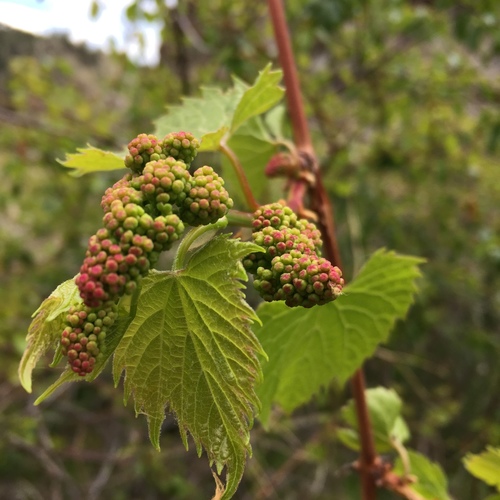
riverbank grape
Vitis riparia
A powerhouse of the North American landscape, the riverbank grape is a fast-growing vine that provides both a lush green privacy screen and a critical food source for backyard visitors. Its frost-sweetened berries and fragrant blooms make it a centerpiece for any wildlife-friendly garden.
Quick Identification
Size
Vine length 10-20 meters (33-65 feet); berries 6-12 mm (0.25-0.5 inches) in diameter
Colors
Lush deep green leaves; reddish-brown shredding bark; dark purple to black fruit with a waxy white 'bloom'
Key Features
- Strong, woody climbing vine with shredding bark
- Three-lobed leaves with sharp, coarse teeth and heart-shaped bases
- Fragrant, small greenish-yellow flower clusters
- Small, dark purple fruit that hangs in tight bunches
When You’ll See Them
Behavior
The riverbank grape is a vigorous, long-lived woody vine that acts as a natural skyscraper in the wild. Using its specialized tendrils, it hitches a ride on trees and fences, often reaching the very top of the canopy to soak up maximum sunlight. It is an ecological powerhouse, providing essential structural support for nests and creating 'wildlife highways' that allow arboreal creatures like squirrels to move safely between trees.
While it is a hardy grower that can occasionally overwhelm smaller garden plants, it is not considered parasitic. Instead, it forms a symbiotic relationship with the local fauna. In the spring, its tiny flowers fill the air with a sweet, musky scent that attracts pollinators, while in the fall, its tart berries become a vital energy source for migrating birds. For humans, it is a resilient landscape addition that offers both shade and a harvest for jellies and juices.
EverydayEarth exclusive
Camera Tips
To capture the most action on your riverbank grape, position your AI-powered camera near the fruit clusters during late summer and early autumn. This is when the vine becomes a 'supermarket' for wildlife. Place the camera at a height of 4 to 6 feet, angled slightly downward toward a heavy bunch of grapes. Because birds like Cedar Waxwings and Northern Cardinals move quickly, use a fast shutter speed or 'burst' mode setting to freeze the action as they pluck berries.
Don't just focus on the fruit! The woody, shredding stems are often used by squirrels and raccoons as natural ladders. Mounting a camera vertically along the main 'trunk' of an older vine can yield fantastic footage of mammals climbing into the canopy. If your camera has a time-lapse feature, use it during the spring to document the incredible speed at which the tendrils find and grip new supports—they can grow several inches in a single day under the right conditions.
For nocturnal visitors like Opossums or Raccoons who love the fallen fermented fruit, place a second camera low to the ground near the base of the vine. Use a wide-angle lens if possible, as these mammals will often linger to forage in the leaf litter. Ensure your IR (infrared) night vision is enabled, as the dark color of the grapes can sometimes blend into the foliage at night. If you're looking for pollinators, focus your camera on the flower panicles in late spring during the mid-morning hours when nectar production is at its peak.
Similar Species
Species that look similar or are commonly confused with riverbank grape.
Summer Grape
Summer grape leaves have a fuzzy, whitish or rusty underside, whereas riverbank grape leaves are mostly smooth and green on both sides.
Virginia Creeper
Look for five leaflets arranged like a hand; riverbank grape has a single, large, heart-shaped leaf with three lobes.
Porcelain Berry
This invasive species has berries that turn bright blue, pink, and purple, unlike the uniform dark purple/black of the riverbank grape.
Frequently Asked Questions
Record riverbank grape at your habitat
Connect a camera to start building your own species record — AI identifies every visitor automatically.