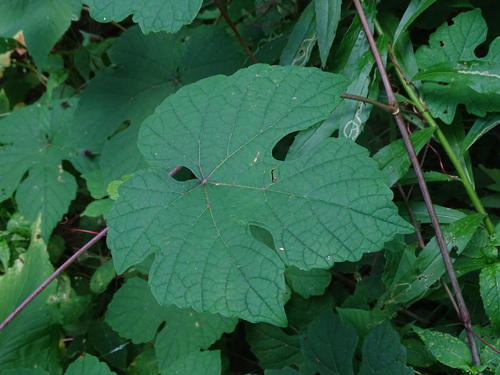
summer grape
Vitis aestivalis
The summer grape is the king of the upland canopy, providing a lush vertical playground and a bountiful purple harvest for your backyard visitors. Its distinctive fuzzy leaves and hardy vines make it a centerpiece of the eastern North American wildscape.
Quick Identification
Size
Vines can reach 33 feet (10 meters) or more in height; leaves are 3-8 inches (7-20 cm) long and slightly wider than they are long.
Colors
Deep green upper leaf surfaces with dense, rusty-brown or whitish hairy undersides; fruit is dark purple to near-black; bark is reddish-brown and shredded.
Key Features
- Leaves are variable, often 3-5 lobed with a fuzzy underside
- Tendrils and flower clusters are absent at every third node
- Small, dark purple grapes in tight clusters
- Bark on older vines peels away in long, thin strips
When You’ll See Them
Behavior
The summer grape is a vigorous, woody perennial vine that acts as a structural architect in the forest. Using specialized tendrils, it climbs high into the canopy of hardwood trees to reach the sunlight. While it is often seen as a competitor to trees, it plays a vital role in the ecosystem by providing a thick vertical habitat that few other plants can offer. In the wild, it forms dense 'grape arbors' that serve as essential nesting sites and high-traffic corridors for arboreal mammals.
Unlike many other wild grapes, the summer grape is specifically adapted to drier upland environments. It doesn't just grow; it colonizes, spreading through both seed dispersal by birds and via its hardy root system. For the backyard observer, this plant is a magnet for activity, acting as a seasonal grocery store for a wide variety of local fauna from mid-summer through the first frosts of autumn.
EverydayEarth exclusive
Camera Tips
To capture the best wildlife action, focus your camera on the fruit clusters rather than the vine as a whole. As the grapes transition from green to deep purple, they become a high-priority target for birds like cardinals, cedar waxwings, and mockingbirds. Mount your camera about 5-8 feet high on a neighboring branch or a specialized pole mount, angling it slightly downward toward a heavy cluster of grapes. Because these birds move quickly, use a fast shutter speed or high-frame-rate video setting to catch the 'snatch and grab' feeding behavior.
Don't just look up—the ground beneath a summer grape vine is a goldmine for trail camera footage. Many grapes fall during the ripening process or are knocked down by messy eaters in the canopy. Positioning a camera 12-18 inches off the ground near the base of the host tree will help you capture nocturnal visitors like raccoons, foxes, and opossums who forage for these fallen fermented treats. This is a great way to see shy mammals that usually stay hidden in the brush.
For those interested in the 'micro-wildlife,' the summer grape's flowers and fruit attract a dizzying array of pollinators and insects. If your camera has a macro or close-focus mode, set it up near the leaf surface during the mid-summer. You can often capture the unique relationship between the vine and various predatory insects that hunt among the leaves. Ensure your camera is placed in a spot that receives dappled sunlight; direct, harsh sun can wash out the deep purple hues of the fruit and make identification difficult in the footage.
Similar Species
Species that look similar or are commonly confused with summer grape.
Riverbank Grape
Leaves are smooth on both sides and it lacks the rusty-colored hairs found on the underside of summer grape leaves.
Fox Grape
Has a tendril or flower cluster at every node, whereas summer grape skips every third node.
Virginia Creeper
Has five distinct leaflets rather than a single lobed leaf; its berries are on red stems and are toxic to humans.
Frequently Asked Questions
Record summer grape at your habitat
Connect a camera to start building your own species record — AI identifies every visitor automatically.