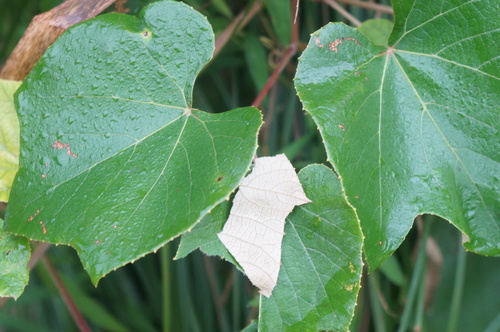
fox grape
Vitis labrusca
The bold, aromatic ancestor of the Concord grape, the Fox Grape is a vertical sanctuary and a wild autumn banquet for backyard visitors. Its 'slip-skin' berries and massive leaves make it an unmistakable icon of the American landscape.
Quick Identification
Size
Vines can grow 15–30 meters (50–100 feet) long; leaves 10–20 cm (4–8 inches) wide; berries 12–20 mm (0.5–0.8 inches) in diameter.
Colors
Large heart-shaped green leaves with distinctive rusty-brown or whitish woolly undersides; fruit ranges from deep purple-black to bronze-amber with a waxy blue-gray 'bloom.'
Key Features
- Slip-skin fruit where the pulp slides easily out of the skin
- Continuous tendrils appearing at nearly every node along the vine
- Woolly, rust-colored hairs on the underside of large, unlobed or shallowly lobed leaves
- Distinctive sweet, musky 'foxy' aroma when the fruit is ripe.
When You’ll See Them
Behavior
Vitis labrusca, commonly known as the Fox Grape, is a vigorous perennial climber that defines the structure of many North American forest edges and backyard fence lines. Unlike many other wild grape species, it is remarkably resilient, boasting a natural resistance to pests like phylloxera and various mildews. It uses its tenacious tendrils to hoist itself upward, often draping over trees and shrubs to create dense, shady canopies that provide vital nesting sites for birds and thermal cover for small mammals.
While it is famously the genetic ancestor of the Concord grape, the wild Fox Grape is a powerhouse of ecosystem interaction. It doesn't just sit still; it reacts to its environment by rapidly sending out new growth toward the strongest light sources. In the garden or backyard, it acts as a vertical highway, allowing arboreal species like squirrels and opossums to move safely above the ground while feasting on its bountiful late-season harvest.
EverydayEarth exclusive
Camera Tips
To capture the incredible diversity of wildlife drawn to Fox Grapes, focus your camera placement on the 'fruiting zone.' During late summer and early autumn, position your camera 4 to 6 feet away from a cluster of ripening grapes. If your camera has a macro or close-focus setting, use it here to capture the stunning detail of the waxy 'bloom' on the berries and the insects, like spicebush swallowtails, that visit the flowers earlier in the year.
Because Fox Grape is a climber, don't limit your camera to the ground. Secure your camera to a trellis, fence post, or tree trunk at eye-level with the vine. This is the 'highway' for nocturnal mammals. Raccoons, Virginia opossums, and even gray foxes are known to climb these vines to reach the sweetest clusters. A side-on angle along the length of a horizontal vine can capture amazing 'tightrope walking' footage of these animals as they forage.
Don't forget the 'clean-up crew' on the ground. As grapes overripen and fall, they attract ground-dwelling birds like Wild Turkeys and Gray Catbirds, as well as mammals like skunks and foxes. Pointing a second camera at the base of the vine, angled slightly upward, will capture the action as animals scrounge through the leaf litter for fallen treasures. This is particularly effective in the cool morning hours when the scent of fallen fruit is most pungent.
For the best lighting, try to position the camera so it is north-facing to avoid the harsh glare of the midday sun through the leaves, which can trigger false motions. The filtered light through the large heart-shaped leaves provides a beautiful, natural green backdrop. If you are looking for birds, use a high-speed trigger setting to catch the rapid movements of Cedar Waxwings or Northern Cardinals as they hover to pluck individual berries from the bunch.
Similar Species
Species that look similar or are commonly confused with fox grape.
Riverbank Grape
Lacks the 'foxy' smell and has deeply lobed, smooth leaves without the rusty woolly underside.
Summer Grape
Has 'interrupted' tendrils (skipping every third node) and leaves that are usually more deeply lobed.
Muscadine
Features much smaller, unlobed leaves with serrated edges and fruit that grows in small, loose clusters rather than large bunches.
Frequently Asked Questions
Record fox grape at your habitat
Connect a camera to start building your own species record — AI identifies every visitor automatically.