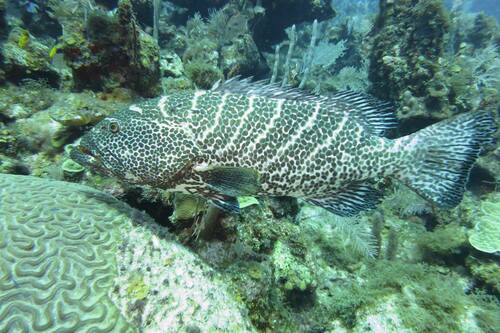
Tiger Grouper
Mycteroperca tigris
With its striking diagonal stripes and imposing silhouette, the Tiger Grouper is the ultimate ambush predator of the Atlantic reefs. A master of disguise and a regular at reef cleaning stations, this charismatic fish is a true icon of the Caribbean underwater world.
Quick Identification
Size
Typically 40–60 cm (16–24 in), reaching a maximum of 100 cm (39 in) and up to 10 kg (22 lbs)
Colors
Dark reddish-brown to grey-green with distinct, pale, diagonal 'tiger' stripes; can change color dramatically during cleaning or spawning.
Key Features
- Bold diagonal pale stripes along the sides
- Strongly protruding lower jaw with canine-like teeth
- Hexagonal pale spots on the head and lower body
- Wide, square-cut tail fin
When You’ll See Them
Geographic range
Where Does the Tiger Grouper Live?
The Tiger Grouper is a quintessential resident of the warm, tropical waters of the Western Atlantic Ocean. Its range begins in the northern reaches of the Bahamas and Southern Florida, extending throughout the Gulf of Mexico and across the entire Caribbean Sea. From the coastal reefs of Central America down to the northern shores of Brazil, this species is a cornerstone of the vibrant coral ecosystems found throughout the Americas.
Basemap © OpenStreetMap contributors
Behavior
The Tiger Grouper is a solitary and highly territorial ambush predator. It spends much of its time lurking near the seafloor, perfectly camouflaged against coral reef structures or tucked inside rocky crevices. Unlike more active hunters, it relies on a 'sit-and-wait' strategy, using its explosive speed to lunge at prey that wanders too close to its hiding spot.
One of the most engaging aspects of Tiger Grouper behavior is its relationship with 'cleaner' species. They are frequent visitors to cleaning stations, where they will hover motionlessly with their mouths agape and gill covers flared, allowing tiny wrasses or shrimp to pick off parasites. They are also known to participate in interspecies hunting, sometimes following foraging octopuses or eels to catch small fish flushed out of hiding.
EverydayEarth exclusive
Camera Tips
Capturing a Tiger Grouper on an AI-powered or stationary camera requires an underwater housing and careful placement near reef structures. If you have access to a coastal 'backyard' reef or pier, mount your camera to a weighted base or a stationary coral head (being careful not to damage live coral). The best placement is near a known 'cleaning station'—look for areas where small, bright blue neon gobies or cleaner wrasses are active, as groupers will visit these spots daily and remain stationary for minutes at a time.
Lighting is the most critical factor for underwater wildlife photography. At depths where the Tiger Grouper lives, red light is absorbed by the water, making the fish look blue or grey. To reveal the striking 'tiger' stripes, use a high-powered underwater video light or a red filter on your lens. Set your camera to a wide-angle view, as these fish can be quite large and often swim close to the lens out of curiosity.
Because Tiger Groupers are ambush predators, they prefer to stay near cover. Point your camera toward ledge openings, small cave entrances, or large sponges. Using a motion-trigger or time-lapse setting is highly effective, as it captures the fish's natural 'hovering' behavior without the bubbles or noise of a diver present to scare them away. Ensure your camera is secured with a safety tether to prevent it from being lost to tides or currents.
Similar Species
Species that look similar or are commonly confused with Tiger Grouper.
Frequently Asked Questions
Record Tiger Grouper at your habitat
Connect a camera to start building your own species record — AI identifies every visitor automatically.