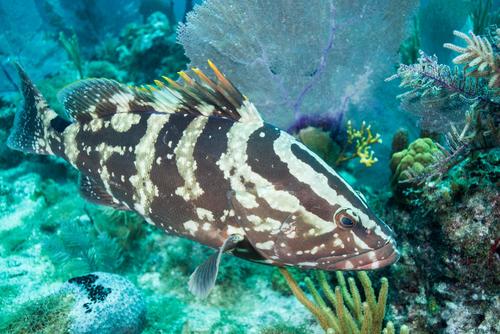
Nassau Grouper
Epinephelus striatus
A friendly and inquisitive resident of the Caribbean, the Nassau Grouper is a master of camouflage and a vital indicator of reef health. Recognizable by its bold vertical bars, this critically endangered fish is a favorite for underwater photographers.
Quick Identification
Size
Length 30–91 cm (12–36 inches); weight up to 25 kg (55 lbs)
Colors
Light tan to tawny background with five distinct dark brown vertical bars and a dark saddle-shaped blotch on the tail base
Key Features
- Five dark vertical bars on the body
- Dark saddle-shaped spot on the base of the tail
- Distinctive 'Y' or 'V' shaped mark on the forehead
- C-shaped tail fin margin
When You’ll See Them
Geographic range
Where Does the Nassau Grouper Live?
Native to the tropical waters of the Western Atlantic, the Nassau Grouper's core range centers on the Bahamas and the Caribbean Sea. It is commonly found throughout the Florida Keys, the Gulf of Mexico, and southward along the Central American coastline to Brazil. These fish are strictly reef-dependent, thriving in the clear, warm waters of coral ecosystems from the shoreline out to the continental shelf edge.
Basemap © OpenStreetMap contributors
Behavior
The Nassau Grouper is the charismatic sentinel of the Caribbean reefs, known more for its inquisitive personality than for hiding in the shadows. Unlike many reef fish that flee at the sight of humans or cameras, the Nassau Grouper is notoriously curious and will often approach observers to investigate. They are primarily solitary and diurnal, spending their daylight hours patrolling reef structures or resting in the shelter of large coral heads.
While they are usually loners, these fish participate in one of nature's most spectacular social events: spawning aggregations. During the winter months, around the full moon, thousands of individuals travel long distances to specific shelf-edge locations to spawn. This predictable behavior made them easy targets for fishing historically, leading to their current protected status in many regions.
EverydayEarth exclusive
Camera Tips
Capturing the Nassau Grouper requires an underwater setup, such as a waterproof action camera or a specialized housing. These fish are highly attracted to structure, so place your camera near a 'cleaning station'—a specific spot on the reef where small shrimp or wrasses remove parasites from larger fish. The grouper will often hover motionless in these areas for several minutes, providing the perfect opportunity for a high-resolution still or video capture.
Because Nassau Groupers are curious, they may actually swim right up to your lens. To take advantage of this, ensure your camera is set to a wide-angle focal length to capture their entire body even at close range. Using a weighted tripod or a 'sand screw' mount is essential to keep the camera steady against the ocean surge. If you are deploying the camera remotely, try to position it so the sun is behind the lens; this prevents the bright Caribbean sun from washing out the fish's intricate vertical bar patterns.
For the best colors, use a red filter if your camera is deeper than 5 meters (15 feet), as water quickly absorbs red light, making the fish look overly blue. If your camera supports it, use a custom white balance calibrated to the depth. In terms of timing, the mid-day sun provides the best natural lighting for underwater videography, though you should check tide charts, as clear water visibility is usually best during an incoming high tide.
Similar Species
Species that look similar or are commonly confused with Nassau Grouper.
Black Grouper
Lacks the dark saddle-shaped spot on the tail and features more block-like, rectangular patterns on its side.
Red Grouper
Has a more uniform reddish-brown color and lacks the sharp, dark vertical bars found on the Nassau.
Tiger Grouper
Features thin, light-colored diagonal stripes that slant across the body, unlike the broad vertical bars of the Nassau.
Frequently Asked Questions
Record Nassau Grouper at your habitat
Connect a camera to start building your own species record — AI identifies every visitor automatically.