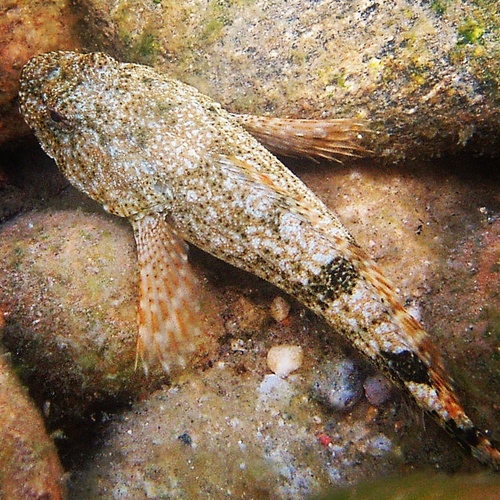
Torrent Sculpin
Cottus rhotheus
The Torrent Sculpin is a master of disguise, hugging the rocky floors of the Pacific Northwest's wildest rivers. With its oversized fins and 'gargoyle' face, it is a fascinating example of evolution in fast-forward.
Quick Identification
Size
Typically 7.5 to 15 cm (3 to 6 inches) in length; maximum recorded length is 15.5 cm (6.1 inches).
Colors
Mottled olive-brown to charcoal grey on the dorsal side with creamy white or pale yellow underbellies; distinctive dark 'saddle' bands cross the back.
Key Features
- Broad, flattened head with a notably wide mouth
- Two dorsal fins with a small dark spot often visible at the rear of the first
- Two or three prominent dark bands (saddles) located under the second dorsal fin
- Large, wing-like pectoral fins used to anchor against fast currents
When You’ll See Them
Geographic range
Where Does the Torrent Sculpin Live?
The Torrent Sculpin is a quintessential resident of the Pacific Northwest in North America. Its native range is centered in the massive Columbia River drainage, stretching from the upper Fraser River in British Columbia, Canada, southward through Washington, Northern Idaho, and Western Montana, reaching its southern limit in the Nehalem River of Oregon. It is primarily found in the cold, oxygen-rich headwaters and mainstems of rivers flowing through the Cascade and Rocky Mountain ranges.
Basemap © OpenStreetMap contributors
Behavior
Torrent Sculpins are the rugged specialists of the riverbed, perfectly engineered for life in turbulent, fast-moving water. Unlike many fish that cruise through the water column, sculpins lack a swim bladder, which means they naturally sink to the bottom. They use their oversized, fan-like pectoral fins to 'wedge' themselves against rocks and gravel, allowing them to remain stationary even in heavy currents that would sweep other fish away. They are highly territorial ambush predators, often spending hours perfectly still, relying on their incredible camouflage to blend in with the river stones.
During the spring breeding season, behavior shifts from solitary hunting to complex social interactions. Males select nesting sites beneath large, flat rocks and undergo a subtle color change to appear darker. They attract females using a combination of acoustic signals—produced by vibrating their bodies—and physical 'head-nodding' displays. After spawning, the male becomes a dedicated guardian, aggressively defending the eggs from predators, including other sculpins, until they hatch. Despite their small size, they are fierce competitors and will readily defend their preferred hunting nook from intruders.
EverydayEarth exclusive
Camera Tips
To capture the Torrent Sculpin on camera, you must go sub-surface. Use a waterproof action camera or a specialized underwater trail camera capable of handling high-pressure flow. Because these fish live in 'torrents,' camera stability is your primary hurdle. Mount your camera to a heavy diving weight or use a custom-built 'river sled'—a flat metal plate that can be tucked under heavy stones—to prevent the current from vibrating the lens and blurring your footage.
Placement is everything for this species. Look for 'riffles'—areas where the water ripples over stones—and place the camera facing a medium-sized flat rock with a small gap underneath. These are prime real estate for sculpins. Position the lens 6 to 10 inches from the target area; because water magnifies objects, a close-focus setting or a macro lens adapter can help capture the intricate mottled patterns on their skin. Side-lighting is often better than top-down lighting, as it highlights the fish's silhouette against the similarly colored gravel.
For the best results, set your camera to a high frame rate (60fps or higher). The Torrent Sculpin’s strike is one of the fastest in the animal kingdom; they can inhale a passing larva in milliseconds, and standard 30fps video often misses the action entirely. If your backyard stream is shallow, aim for midday filming when the sun is directly overhead to penetrate the water's surface, but if the water is deep or murky, you will likely need an auxiliary waterproof LED light to bring out the subtle greens and browns of their camouflage.
Similar Species
Species that look similar or are commonly confused with Torrent Sculpin.
Frequently Asked Questions
Record Torrent Sculpin at your habitat
Connect a camera to start building your own species record — AI identifies every visitor automatically.