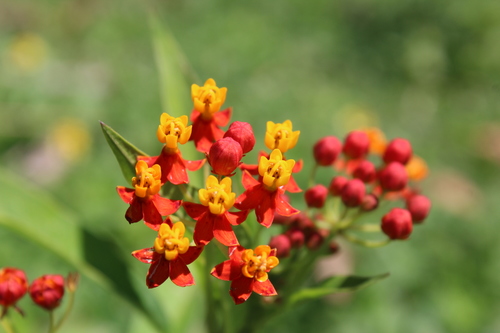
tropical milkweed
Asclepias curassavica
A vibrant, sun-loving tropical beauty that serves as the essential nursery and fueling station for the iconic Monarch butterfly.
Quick Identification
Size
60 to 120 cm (2 to 4 feet) tall, with a spread of 30 to 60 cm (1 to 2 feet)
Colors
Brilliant red or deep orange petals (corollas) with bright yellow or gold central hoods; stems and leaves are a rich medium-to-dark green.
Key Features
- Clusters of bi-color red-orange and yellow flowers
- Narrow, lance-shaped leaves growing in opposite pairs
- Stems bleed a thick, milky white sap when broken
- Erect, spindle-shaped seed pods that split to release silky-haired seeds
When You’ll See Them
Geographic range
Where Does the tropical milkweed Live?
Native to the American tropics, Tropical Milkweed originally flourished throughout Mexico, Central America, and South America. Because of its beauty and utility for butterflies, it has been introduced worldwide and is now found in nearly all tropical and subtropical regions. In the United States, it is most common in Florida, Texas, and California, while internationally it has established populations across Africa, Southeast Asia, and Australia.
Basemap © OpenStreetMap contributors
Behavior
Tropical milkweed is a fast-growing perennial subshrub that acts as a vital hub for backyard biodiversity. Unlike many other garden plants, its primary 'behavior' is its role as a host plant; it is one of the preferred nurseries for Monarch butterflies. The plant contains cardiac glycosides, which are toxic to most herbivores but are sequestered by Monarch caterpillars, making them unpalatable to predators like birds.
In the garden, this species is known for its long blooming period and its ability to attract a wide array of pollinators including bees, wasps, and various butterfly species. While it is a beloved ornamental, it is important to note that in very warm climates where it doesn't die back in winter, it can disrupt Monarch migration patterns or host a parasite known as OE (Ophryocystis elektroscirrha). Gardeners are often encouraged to cut the plant back in late fall to mimic natural cycles.
EverydayEarth exclusive
Camera Tips
Capturing tropical milkweed on your AI-powered camera is less about the plant itself and more about the incredible 'micro-wildlife' it attracts. To get the best shots, position your camera on a tripod or mount it very close to a cluster of blooms—ideally 1 to 2 feet away. Angle the lens slightly upward to catch the underside of the flowers where butterflies often perch, and to ensure you have a clean background that makes the vibrant red and yellow colors pop.
Lighting is crucial for this species. The best photos usually occur during the 'golden hours' of early morning or late afternoon when the sun isn't too harsh, as midday sun can wash out the intense reds of the petals. If your camera allows for manual settings, use a high shutter speed (at least 1/500s) to freeze the motion of butterfly wings or the rapid movements of hovering clearwing moths.
Don't just focus on the flowers; try placing a second camera lower down on the plant to document the growth of Monarch caterpillars. These larvae are most active during the day and can be seen voraciously eating the leaves. Seeing the transition from a tiny egg to a large, striped caterpillar provides a fascinating time-lapse opportunity. If you are using a motion-activated camera, ensure the sensitivity is set to high, as insects are small and may not trigger sensors designed for larger mammals.
Finally, consider the seasonal timing. While the plant may bloom for months, the peak 'action' occurs when Monarchs are migrating or breeding. In many regions, this is late summer. Keep the area around the plant clear of tall weeds that might blow in the wind and cause 'false triggers' on your camera, ensuring you only capture the moments when a pollinator actually lands.
Similar Species
Species that look similar or are commonly confused with tropical milkweed.
Frequently Asked Questions
Record tropical milkweed at your habitat
Connect a camera to start building your own species record — AI identifies every visitor automatically.