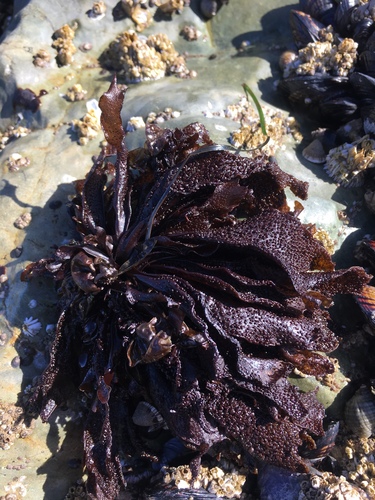
Turkish washcloth
Mastocarpus papillatus
Meet the ocean's most resilient 'terrycloth.' This bumpy red seaweed thrives where most life can't—baking in the sun between the crashing waves of the Pacific coast.
Quick Identification
Size
Blades typically range from 2 to 15 cm (1 to 6 inches) in length, forming dense, bushy clumps.
Colors
Deep reddish-purple, chocolate brown, or nearly black; may bleach to a pale tan or yellowish-green when exposed to heavy sun.
Key Features
- Bumpy, nipple-like projections called papillae on female plants
- Deep reddish-purple to brownish-black coloration
- Small, rubbery fan-shaped blades usually 1-6 inches long
- Found primarily in the mid-to-high rocky intertidal zones
When You’ll See Them
Behavior
While it may appear stationary, the Turkish washcloth exhibits a fascinating survival strategy known as heteromorphic alternation of generations. In one phase, it looks like a crusty black spot on a rock (often called the 'petrocelis' stage), while in the other, it grows into the familiar upright, bumpy blades. This allows the species to survive varying environmental pressures, from grazing snails to crashing waves and intense sun exposure.
In the intertidal 'backyard,' this algae serves as a vital micro-habitat. During low tide, the dense clumps of Turkish washcloth trap moisture, providing a cool, damp refuge for tiny crustaceans, snails, and limpets that would otherwise desiccate. Though it doesn't interact with humans in a traditional social sense, it is a staple of the Pacific coastline, often used by educators to demonstrate the resilience of marine life.
EverydayEarth exclusive
Camera Tips
To capture the Turkish washcloth on your coastal trail camera, timing is everything. Because this species lives in the intertidal zone, you’ll want to position your camera during a negative tide when the 'washcloth' texture is fully exposed and dry enough to show detail. Use a low-profile tripod or a weighted bean bag to secure your camera just inches above the rock surface. A macro lens or a camera with a dedicated macro mode is essential to resolve the tiny, nipple-like papillae that give this seaweed its name; without close-up capability, it may simply look like a dark smudge on the rocks.
Lighting can be tricky on the wet, reflective surfaces of the intertidal zone. For the best results, aim for the 'golden hour' or slightly overcast days to minimize harsh, white highlights on the damp blades. If your camera setup allows for filters, a circular polarizer is a game-changer; it will cut through the glare on the wet surfaces, revealing the deep purples and rich chocolate tones that are often lost in bright reflections. If you are using a waterproof action camera, consider a long-duration timelapse to document the dramatic transformation as the tide returns and the shriveled, dry plant rehydrates and begins to sway in the current.
Safety for your gear is paramount in this environment. Ensure your camera housing is rated for saltwater and thoroughly rinse it with fresh water after every session to prevent salt crystals from corroding the seals. Since Turkish washcloth is stationary, you don't need a fast shutter speed, but you should use a high f-stop (small aperture) to ensure the entire clump is in focus from front to back. This is an excellent species for testing your camera's ability to capture high-contrast textures and fine organic details in a rugged, natural setting.
Similar Species
Species that look similar or are commonly confused with Turkish washcloth.
Frequently Asked Questions
Record Turkish washcloth at your habitat
Connect a camera to start building your own species record — AI identifies every visitor automatically.