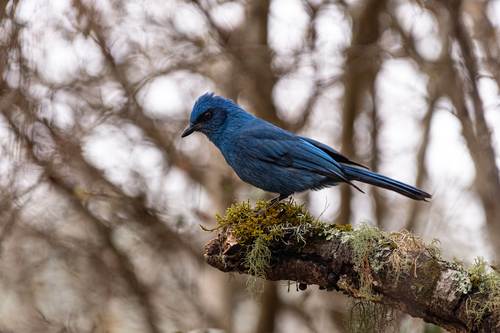
Unicolored Jay
Aphelocoma unicolor
A hidden gem of the high-altitude cloud forests, the Unicolored Jay is draped in a solid coat of breathtaking indigo. This social, intelligent bird brings a flash of deep cerulean to the misty canopy.
Quick Identification
Size
Length: 27-32 cm (10.5-12.5 in); Weight: 110-140 g (3.9-4.9 oz)
Colors
Uniform deep cerulean to indigo blue across the entire body; subtle blackish tones on the lores and around the eyes; black beak and legs.
Key Features
- Solid indigo-blue plumage with no white or gray markings
- Heavy, powerful black beak
- Long, graduated tail
- Lacks a crest on the head
When You’ll See Them
Behavior
The Unicolored Jay is a highly social and intelligent corvid, typically found in small family groups of 5 to 10 individuals. They are famous for their cooperative breeding habits, where offspring from previous years remain with their parents to help protect the nest and feed new chicks. This creates a complex social dynamic that is a joy to observe on camera, as the birds often engage in vocal 'conversations' and communal foraging.
While they can be bold within their family groups, they are generally more reclusive than their northern cousins, preferring the dense cover of high-altitude cloud forests. They are vocal birds, using a variety of harsh, rasping calls to signal danger or coordinate movements through the canopy. In areas where they are accustomed to human presence, they may investigate gardens or clearings, but they rarely stray far from the humid, moss-draped trees they call home.
EverydayEarth exclusive
Camera Tips
To capture the stunning indigo plumage of the Unicolored Jay, camera placement is everything. These birds are canopy-dwellers that descend to the mid-story or ground primarily for food or water. Position your camera at a height of 5 to 6 feet, facing a clear landing branch or a flat mossy rock. Because cloud forests are often dimly lit and misty, try to find a spot that receives 'dappled' sunlight; this will allow your AI camera to capture the bird's true blue color without the sensor defaulting to grainy black-and-white night mode during the day.
If you are setting up a backyard camera in a high-altitude region, platform feeders are highly effective. Bait the area with high-energy foods like suet, peanuts (unsalted), or local acorns. Unicolored Jays are intelligent and will quickly memorize the location of a reliable food source. To get the best 'hero' shots, place the bait behind a natural element like a piece of bark or a pinecone so the bird appears to be foraging naturally rather than eating from a plastic tray.
These jays are fast and can be twitchy, so set your camera to a high trigger speed—ideally 0.3 seconds or faster. Use a multi-shot burst mode (3-5 frames per trigger) to capture the perfect moment when the bird is still or looking directly at the lens. Because they travel in family groups, one bird arriving often means four or five more are right behind it; consider setting a short 'retrigger delay' (5-10 seconds) so you don't miss the social interactions that follow the first arrival.
Finally, keep your lens clean! The humid environment these jays prefer is prone to condensation and algae growth on camera housings. Check your equipment weekly and use a rain shield if possible. If the camera supports it, increasing the exposure compensation by +0.3 or +0.7 can help bring out the details in their dark blue feathers against the often-bright, misty background of the forest.
Similar Species
Species that look similar or are commonly confused with Unicolored Jay.
Frequently Asked Questions
Record Unicolored Jay at your habitat
Connect a camera to start building your own species record — AI identifies every visitor automatically.