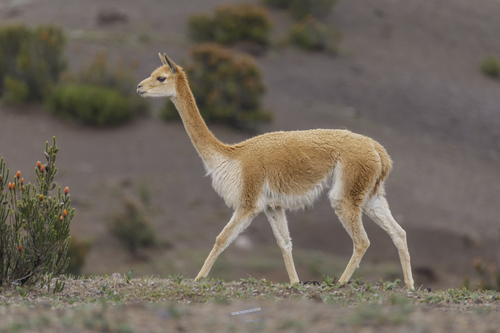
Vicuña
Lama vicugna
The graceful vicuña is the golden ghost of the Andes, prized for its ethereal wool and celebrated as the wild ancestor of the alpaca. Living at the roof of the world, these elegant camelids are a masterpiece of high-altitude evolution.
Quick Identification
Size
Height: 75-85 cm (30-33 in) at shoulder; Length: 1.45-1.6 m (4.8-5.2 ft); Weight: 35-65 kg (77-143 lbs)
Colors
Tawny or cinnamon-brown upperparts with a creamy white underbelly and a distinctive long white 'bib' of hair on the chest.
Key Features
- Slender, elegant build with long neck and thin legs
- Large, dark eyes with thick lashes for protection
- Distinctive patch of long white hair on the chest
- Continuous growing lower incisors similar to a rodent
When You’ll See Them
Geographic range
Where Does the Vicuña Live?
The vicuña is native to the high-altitude regions of the South American Andes. Its core range spans the central and southern mountain range, primarily concentrated in the 'Puna' ecosystem of Peru, Bolivia, northwestern Argentina, and northern Chile. Small introduced populations also exist in the highlands of Ecuador. They are specialists of the thin mountain air, rarely descending below the high-altitude plateaus they call home.
Basemap © OpenStreetMap contributors
Behavior
Vicuñas are highly social and organized animals that live in stable family groups. Each group typically consists of one dominant alpha male, several females, and their young offspring, known as 'crias.' They are territorial, with the male defending a specific grazing area and a separate sleeping area on higher ground. These animals are strictly diurnal, meaning they spend the daylight hours foraging in the lower valleys and retreat to safer, steeper slopes at night to avoid predators like pumas and Andean foxes.
Unlike their domestic relatives, the llama and alpaca, vicuñas are extremely shy and flighty. They have incredible eyesight and use a high-pitched, whistling alarm call to alert the herd to danger. Once alerted, the herd can flee at speeds of up to 50 km/h (31 mph). While they are wild, they have a deep cultural connection to humans; the indigenous people of the Andes have practiced 'Chaccu' for centuries—a ritual where vicuñas are herded, shorn for their precious wool, and then released back into the wild unharmed.
EverydayEarth exclusive
Camera Tips
To successfully capture the elusive vicuña on a trail camera, you must focus on 'bofedales'—the high-altitude wetlands or green marshy patches that serve as critical watering and feeding holes in an otherwise arid landscape. These areas are the social hubs of the puna. Because there are no trees in this environment, you will need to get creative with mounting. Use a low-profile tripod or secure your camera to a large, stable rock using a heavy-duty strap. Position the lens about 3 feet (1 meter) off the ground to ensure you capture the full body of the animal against the mountain backdrop.
Vicuñas have exceptional vision and are naturally suspicious of new objects. To avoid 'camera-shyness,' it is vital to camouflage your device. Use local moss, dried bunchgrass, or even a specialized protective housing that mimics the color of the local volcanic rock. Avoid any dangling straps or shiny surfaces that might catch the light. Set your camera to a fast trigger speed—0.5 seconds or less—as these animals move with a light, springy gait that can easily result in a missed shot or a blur.
A professional tip for capturing consistent vicuña activity is to locate their communal dung piles, known as latrines. Vicuñas are creatures of habit and use these specific spots to mark their territory. Placing a camera near a well-used latrine ensures you will capture multiple members of the herd and potentially witness interesting social behaviors. Since the Andean sun is incredibly bright, use a camera with a high dynamic range (HDR) or adjust your exposure settings to prevent the white chest fur from being 'blown out' in the midday glare. Early morning and late afternoon provide the most flattering light for their golden coats.
Similar Species
Species that look similar or are commonly confused with Vicuña.
Frequently Asked Questions
Record Vicuña at your habitat
Connect a camera to start building your own species record — AI identifies every visitor automatically.