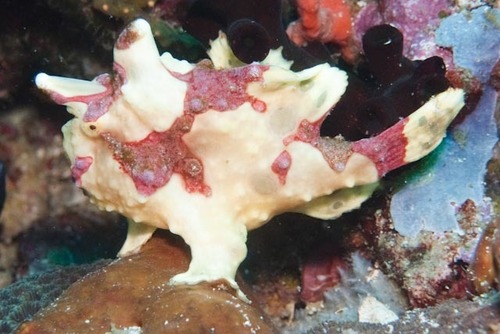
Warty Anglerfish
Antennarius maculatus
Meet the ocean's most patient fisherman, the Warty Anglerfish. With its spectacular camouflage and a built-in fishing rod, this master of disguise proves that looks can be both bizarre and incredibly effective.
Quick Identification
Size
Length of 5-15 cm (2-6 inches); stocky, globose body weighing less than 0.5 kg (1 lb)
Colors
Highly polymorphic; can appear in white, yellow, pink, red, brown, or black with contrasting dark circular spots and warty skin textures
Key Features
- Distinctive warty or cauliflower-like skin texture
- Modified first dorsal spine (illicium) with a lure (esca) that resembles a small shrimp
- Large, hand-like pectoral fins used for 'walking' on the seabed
- Extremely large, upward-pointing mouth capable of rapid expansion
When You’ll See Them
Geographic range
Where Does the Warty Anglerfish Live?
The Warty Anglerfish is a resident of the tropical Indo-Pacific, thriving in the warm, nutrient-rich waters of the Eastern Indian Ocean and Western Pacific. Its core population density is highest within the Coral Triangle, spanning the archipelagoes of Indonesia, the Philippines, and Papua New Guinea. You can also find this master of disguise as far west as Mauritius and as far north as the subtropical reefs of southern Japan, as well as along the northern coasts of Australia.
Basemap © OpenStreetMap contributors
Behavior
The Warty Anglerfish is a sedentary ambush predator that relies almost entirely on its incredible camouflage to survive. Instead of swimming, it often uses its modified pectoral and pelvic fins to 'walk' slowly across the reef or through sponge gardens. This species is a master of aggressive mimicry, using its illicium—a biological fishing rod—tipped with a lure that it wiggles to attract unsuspecting prey. When a target gets close enough, the anglerfish expands its oral cavity so quickly that it creates a vacuum, swallowing the prey in as little as six milliseconds.
Socially, these fish are solitary and highly territorial. They spend the majority of their lives stationary, perfectly blending in with the sponges and corals they inhabit. Interaction with humans is mostly limited to underwater photographers and divers; the fish is generally oblivious to observers, trusting its camouflage to remain undetected. They are not aggressive toward humans but can be highly cannibalistic toward smaller members of their own kind.
EverydayEarth exclusive
Camera Tips
To capture the Warty Anglerfish on an underwater trail camera, the primary challenge is finding the fish before the camera does. These creatures are experts at mimicking sponges, so look for vibrant reef sections at depths of 5 to 15 meters that are densely populated with *Clathria* or *Haliclona* sponges. Mount your camera on a stable, weighted base or a flexible tripod arm secured to a dead coral head to ensure the frame remains steady against current and surge.
Because the Warty Anglerfish moves so little, traditional motion-trigger sensors often fail to detect it. The most effective strategy is to use a high-frequency time-lapse setting. Setting the camera to take a photo or a 10-second video every 30 to 60 seconds will significantly increase your chances of capturing the 'strike'—a movement so fast it is almost invisible to the naked eye. If you are using a camera with adjustable focal lengths, a macro setting is essential to capture the intricate, wart-like textures and the rhythmic movement of the fishing lure.
Lighting is crucial for revealing the anglerfish’s true colors, which are often lost in the blue-green filter of the ocean. If filming during the day, position your camera so the sun is behind it, illuminating the reef. For night captures, use a diffused, wide-angle video light rather than a direct beam, as harsh light may cause small prey fish to flee the area, leaving your anglerfish with nothing to hunt. Position the camera at a 'fish-eye' level—roughly 10-15 cm from the substrate—to get a dramatic profile shot of the fish's lure and mouth.
Similar Species
Species that look similar or are commonly confused with Warty Anglerfish.
Frequently Asked Questions
Record Warty Anglerfish at your habitat
Connect a camera to start building your own species record — AI identifies every visitor automatically.