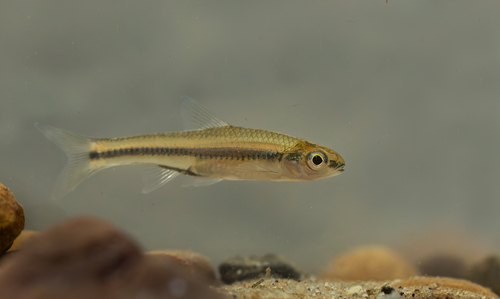
Weed Shiner
Alburnops texanus
A shimmering highlight of Southern waterways, the Weed Shiner is a master of the underwater thicket. This small, social minnow is the perfect subject for those looking to explore the hidden life of backyard streams and ponds.
Quick Identification
Size
Small minnow ranging from 5 to 8.5 cm (2 to 3.3 inches) in length; weight is negligible, typically under 10 grams (0.35 oz).
Colors
Silvery sides with a yellowish or olive-tinted back. A prominent dark lateral stripe runs from the snout to the tail, often ending in a small dark spot. Breeding males may develop a rosy or orange tint on their fins.
Key Features
- Dark lateral stripe extending through the eye to the snout
- Terminal to slightly subterminal mouth
- 7-8 anal fin rays
- Large, visible scales with dark edges on the upper body
When You’ll See Them
Behavior
The Weed Shiner is a social, schooling fish that spends much of its time navigating the mid-water columns of slow-moving streams and lake margins. They are highly gregarious, often found in the company of other shiner species, using their collective numbers to discourage predators like bass or herons. Despite their small size, they are quite active and constantly on the move, darting in and out of aquatic vegetation.
In terms of social hierarchy, Weed Shiners don't exhibit strong territoriality except during the spawning season. They are peaceful inhabitants of the waterway and do not interact much with humans, though they are sensitive to water quality and habitat disruption. Their presence is often considered an indicator of a healthy, well-oxygenated aquatic ecosystem with plenty of natural cover.
EverydayEarth exclusive
Camera Tips
Capturing the Weed Shiner requires a specialized approach since they are entirely aquatic. For the best results, use a dedicated underwater action camera or a trail camera equipped with a high-quality waterproof housing. Position the camera at a depth of 12 to 24 inches, facing a patch of submerged vegetation or a 'clearing' in a sandy-bottomed stream. Avoid placing the lens in direct sunlight to prevent glare; instead, aim for a spot where dappled sunlight filters through the water surface to highlight their silvery scales.
Because these fish are small and fast, set your camera to a high frame rate (at least 60 FPS) to capture smooth motion. Using a wide-angle lens is beneficial as it allows you to see the entire school as they pass by. If you are using a stationary setup in a backyard pond or a slow creek, you can encourage them to linger in front of the lens by placing a small mesh bag filled with crushed fish flakes or breadcrumbs just out of the camera's frame. The scent will draw the school in without cluttering the shot with debris.
Clarity is your biggest challenge. Wait for a period of dry weather when the water is clear and sediment has settled. If you are filming in a backyard water feature, ensure your filtration system is running well but not creating so much turbulence that the fish are pushed out of frame. Early morning light often provides the most natural 'glow' for their lateral stripes, making identification much easier in your footage.
Similar Species
Species that look similar or are commonly confused with Weed Shiner.
Frequently Asked Questions
Record Weed Shiner at your habitat
Connect a camera to start building your own species record — AI identifies every visitor automatically.