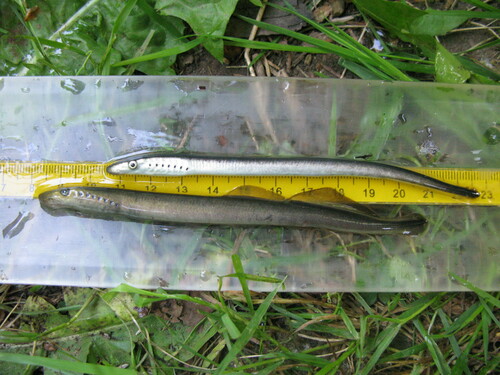
Western Brook Lamprey
Lampetra richardsoni
A mysterious 'living fossil' of the Pacific Northwest, the Western Brook Lamprey is a non-parasitic, jawless fish that spends its life hidden in the stream beds of coastal waterways.
Quick Identification
Size
Adults typically reach 12–18 cm (4.7–7.1 inches) in length and weigh only a few grams.
Colors
Adults are dark olive-green to slate-gray on the dorsal side, fading to a pale yellow or silvery-white belly. Larvae are generally tan or brownish to blend with sediment.
Key Features
- Jawless, disc-shaped mouth with blunt teeth
- Seven rounded gill openings behind each eye
- Eel-like body lacking paired fins
- Small size, rarely exceeding 7 inches in length
When You’ll See Them
Geographic range
Where Does the Western Brook Lamprey Live?
This species is a permanent resident of the freshwater coastal watersheds along the Pacific coast of North America. It can be found from the Taku River in southern Alaska, through British Columbia and Vancouver Island, down into Washington, Oregon, and as far south as the Sacramento-San Joaquin drainage in central California. Unlike some other lampreys, they do not migrate to the ocean, spending their entire lives within the same river systems.
Basemap © OpenStreetMap contributors
Behavior
The Western Brook Lamprey follows a fascinating and somewhat tragic life cycle. For the majority of its life—anywhere from three to seven years—it exists as a blind, worm-like larva called an ammocoete. During this stage, it remains buried in the soft silt and sand of stream bottoms, acting as a vital filter feeder that cleans the water by consuming detritus and microscopic algae.
Upon reaching maturity, the lamprey undergoes a dramatic metamorphosis, developing eyes and a suction-cup mouth. Unlike many of its relatives, the Western Brook Lamprey is non-parasitic. Its digestive system actually atrophies during metamorphosis, meaning the adult never eats again. They emerge from the sediment in late winter or spring to engage in a final, communal spawning event in gravelly riffles, often moving small stones with their mouths to build nests before dying shortly after.
EverydayEarth exclusive
Camera Tips
Capturing the Western Brook Lamprey requires a specialized approach since they are entirely aquatic and mostly nocturnal. The best time to see them is during their spawning window from March to July. Look for shallow, gravel-bottomed sections of clear streams (riffles) where the current is steady but not overwhelming. You are looking for 'nests'—small, cleared-out depressions in the gravel where groups of lampreys congregate to spawn.
Because they are active at night, an underwater camera or a trail camera with high-quality infrared (IR) night vision is essential. Standard white-light flashes can be too reflective underwater and may startle the fish. If using a trail camera from the bank, mount it on a tripod or a low stake pointed down at a 45-degree angle into a shallow pool. To eliminate surface glare during the day, use a polarizing filter over the camera lens.
For the best results, use an action camera in a waterproof housing submerged directly in the stream, or a dedicated underwater 'fishing' camera. Place the camera near the downstream edge of a gravel riffle. Since adults do not feed, traditional baits are useless. Instead, focus on habitat: find the areas where silty larval beds meet gravelly spawning grounds. Set your camera to video mode, as the undulating, eel-like swimming motion of the lamprey is much easier to identify and more compelling to watch than a still photo.
Similar Species
Species that look similar or are commonly confused with Western Brook Lamprey.
Frequently Asked Questions
Record Western Brook Lamprey at your habitat
Connect a camera to start building your own species record — AI identifies every visitor automatically.