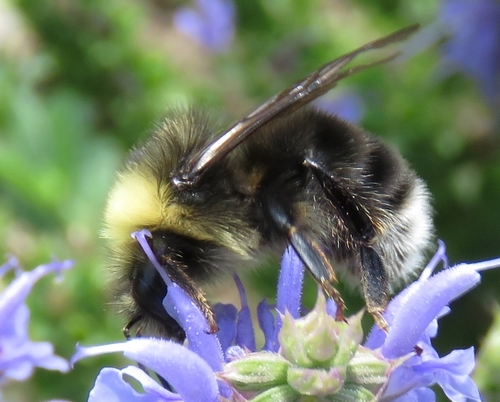
Western Bumble Bee
Bombus occidentalis
Recognizable by the snowy white tip of its abdomen, the Western Bumble Bee is a master of buzz pollination and a vital guardian of western North American wildflowers.
Quick Identification
Size
Length: 9-25 mm (0.35-1.0 in); Queens are significantly larger than workers and males.
Colors
Black and yellow banded thorax with a signature white or pale-yellow tip at the end of the abdomen.
Key Features
- Distinctive white or pale-white tip on the abdomen
- Yellow hair on the front of the thorax, black between the wings
- Short, rounded face compared to other bumble bee species
- Fuzzy, robust body typical of the Bombus genus
When You’ll See Them
Geographic range
Where Does the Western Bumble Bee Live?
Native to the vast landscapes of western North America, the Western Bumble Bee historically occupied a massive territory stretching from the southern reaches of Alaska and the Yukon down through British Columbia. In the United States, its core range encompasses the Pacific Northwest, the Rocky Mountains, and the Sierra Nevada, extending as far south as New Mexico and Arizona. While it was once one of the most prevalent bee species in the region, its distribution has become increasingly patchy in recent decades, with populations now more frequently found in higher-elevation habitats and northern latitudes.
Basemap © OpenStreetMap contributors
Behavior
The Western Bumble Bee is a highly social insect that operates in annual colonies. Each spring, a solitary queen emerges from hibernation to find a suitable underground nesting site, frequently repurposing abandoned rodent burrows. She is responsible for the first generation of workers, who eventually take over the tasks of foraging, nest maintenance, and colony defense. Unlike honey bees, these colonies are smaller and do not survive the winter; only new queens hibernate to start the cycle again the following year.
These bees are famously industrious foragers and use a technique known as 'buzz pollination.' By grabbing a flower and vibrating their flight muscles at a specific frequency, they can dislodge pollen that is tucked deep within the anthers of certain plants. This makes them essential for the reproduction of many native wildflowers and agricultural crops. While they are capable of stinging to defend their nest, they are generally peaceful while foraging and will ignore humans if left undisturbed.
EverydayEarth exclusive
Camera Tips
To successfully capture the Western Bumble Bee on a backyard camera, focus your efforts on 'pollinator pathways' within your garden. Position your camera approximately 12 to 24 inches away from high-value nectar plants like lavender, bee balm, or native lupines. Because these bees are small and fast, using a camera with a dedicated macro mode or a high-quality close-up lens is vital for capturing the detail of the white-tipped abdomen that distinguishes this species from its cousins.
Lighting is the most critical factor for insect photography. Aim your camera toward the west or east to catch the low-angle sun during the morning and late afternoon, which highlights the fuzzy texture of the bee's coat. Avoid placing the camera where it will be in deep shadow, as the black parts of the bee's body will lose all detail. A fast shutter speed or a high frame-rate video setting is recommended to freeze the rapid movement of their wings and prevent motion blur during flight.
Consider the height of your setup based on what is blooming. If you have ground-covering clover or low-growing wildflowers, a tripod at ground level is best. For taller shrubs or stalks, mount your camera at eye level. Avoid using artificial lures like sugar water, which can attract ants or wasps that might deter the bees; instead, ensure you have a variety of native plants with different bloom times to keep the bees returning to the same spot throughout the season.
Similar Species
Species that look similar or are commonly confused with Western Bumble Bee.
Yellow-faced Bumble Bee
The yellow-faced bumble bee has a yellow band on the abdomen but lacks the distinctive white-tipped tail found on the Western Bumble Bee.
Yellow-banded Bumble Bee
While it also has a pale tip, the yellow-banded bumble bee has more extensive yellow markings on the mid-section of its abdomen.
Frequently Asked Questions
Record Western Bumble Bee at your habitat
Connect a camera to start building your own species record — AI identifies every visitor automatically.