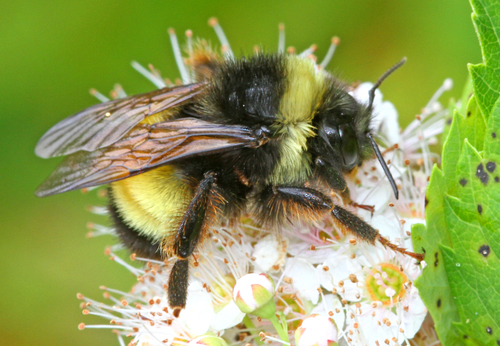
Yellow-banded Bumble Bee
Bombus terricola
Meet the resilient Yellow-banded Bumble Bee, a master of the cold and a vital pollinator for northern gardens. With its striking black and gold stripes, this fuzzy visitor is a sign of a healthy, thriving ecosystem.
Quick Identification
Size
Queens: 19–21 mm (0.75–0.83 in); Workers: 10–15 mm (0.4–0.6 in); Males: 13–15 mm (0.5–0.6 in)
Colors
Distinctive yellow bands on the second and third abdominal segments; predominantly black thorax with a yellow band across the front; the tip of the abdomen is typically black
Key Features
- Broad yellow band across abdominal segments 2 and 3
- Black head and black rear-half of the abdomen
- Yellow band on the anterior (front) part of the thorax
- Short-tongued species with a robust, fuzzy build
When You’ll See Them
Geographic range
Where Does the Yellow-banded Bumble Bee Live?
The Yellow-banded Bumble Bee is native to the northern regions of North America, spanning a vast area from the maritime provinces of Canada across to the eastern and midwestern United States. Its core range includes the Great Lakes region and New England, extending southward through the higher elevations of the Appalachian Mountains. While historically widespread, its population is now most concentrated in the northernmost parts of its range and higher altitude pockets where cooler climates prevail.
Basemap © OpenStreetMap contributors
Behavior
The Yellow-banded Bumble Bee is a social insect with a sophisticated colony structure. Each spring, a solitary queen emerges from hibernation to find an underground nesting site, often repurposing abandoned rodent burrows or hollow logs. Once she produces her first batch of workers, the colony grows rapidly, with the queen shifting her focus entirely to egg-laying while the workers forage for the colony's survival.
These bees are exceptionally hardy and are known for their ability to regulate their internal temperature. By shivering their flight muscles, they can generate enough heat to fly in temperatures that would ground most other insects, making them one of the first pollinators seen in early spring. They are also known for 'nectar robbing,' a behavior where they use their short mouthparts to bite a hole in the base of a long flower to reach nectar they couldn't otherwise access.
EverydayEarth exclusive
Camera Tips
To capture the Yellow-banded Bumble Bee on your backyard camera, focus your efforts on 'pollinator magnets.' Native plants such as Monarda (Bee Balm), Goldenrod, and Asters are irresistible to this species. Position your camera within 12 to 18 inches of the flower heads for a macro-style view. Since these bees move quickly, using a camera with a high-speed trigger or a video mode that allows you to extract still frames is essential.
Lighting is your best friend when filming insects. Place your camera in a spot that receives full morning sun. The bright light allows the camera to use a faster shutter speed, which is necessary to freeze the motion of their rapidly vibrating wings. Avoid placing the camera where it will be shaded by the plant itself, as this can lead to grainy or blurry footage.
Because the Yellow-banded Bumble Bee is most active in the late spring and summer, ensure your camera is deployed by early May to catch the queens emerging. To attract them specifically to a camera station, avoid using sugar water feeders which can spread disease; instead, provide a diverse array of native blooms that offer continuous nectar throughout the season. Keep the camera lens clean and free of pollen dust for the sharpest identification shots.
Similar Species
Species that look similar or are commonly confused with Yellow-banded Bumble Bee.
Rusty-patched Bumble Bee
Look for a small rusty-brown patch on the second abdominal segment, which is surrounded by yellow.
American Bumble Bee
Has a yellow thorax with a central black spot and yellow on the first three abdominal segments.
Common Eastern Bumble Bee
Only has one yellow band on the first abdominal segment, whereas the Yellow-banded has two bands on segments 2 and 3.
Frequently Asked Questions
Record Yellow-banded Bumble Bee at your habitat
Connect a camera to start building your own species record — AI identifies every visitor automatically.