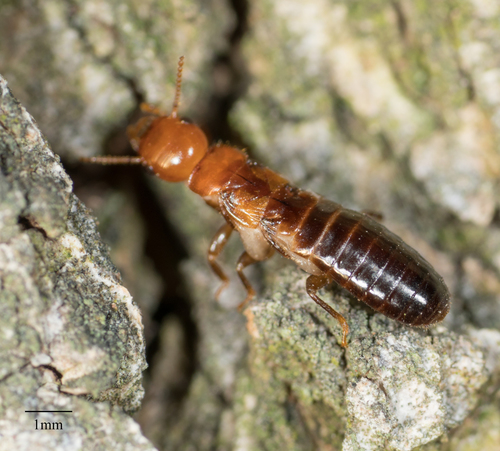
Western Drywood Termite
Incisitermes minor
The Western Drywood Termite is a master of hidden architecture, living entirely within the wood it consumes. While they are famous for their structural impact, their annual autumn swarming flights provide a unique window into the life of these secretive social insects.
Quick Identification
Size
Workers/Soldiers: 10-12 mm (0.4-0.5 in); Alates: 11-13 mm (0.45-0.5 in) including wings
Colors
Alates have dark brown bodies with a reddish-brown head; soldiers are creamy white with orange-brown heads and black mandibles.
Key Features
- Reddish-brown head on dark-bodied winged swarmers
- Hard, hexagonal fecal pellets (frass) pushed out of holes
- Soldiers have large mandibles and a rectangular, dark head
- Smoky-black wings with two heavy veins along the front edge
When You’ll See Them
Geographic range
Where Does the Western Drywood Termite Live?
Originally native to the arid and semi-arid regions of western North America, the Western Drywood Termite is most densely populated throughout California, Arizona, and northwestern Mexico. Because they are easily transported within wooden crates and furniture, they have expanded their footprint significantly, establishing populations across the southern United States into Florida and as far north as Toronto. They are also common introduced pests in Hawaii, Japan, and parts of coastal China, thriving wherever warm temperatures and dry wood coexist.
Basemap © OpenStreetMap contributors
Behavior
The Western Drywood Termite is a cryptic and resilient insect that lives its entire life within sound, dry wood. Unlike subterranean termites, this species does not require contact with the soil or a constant water source. Instead, they extract moisture from the wood they consume and through metabolic processes, making them exceptionally difficult to detect until a colony is well-established. They live in relatively small social groups of a few thousand individuals, often lacking a true worker caste; instead, immature termites called 'pseudergates' perform the labor for the colony.
Their most notable public appearance occurs during 'nuptial flights' or swarming. On warm, sunny days—typically in the late summer or autumn—winged reproductives (alates) emerge from the colony in large numbers to find mates and start new colonies. After a short flight, they shed their wings and seek out small crevices in wood to begin their new life as a king and queen. In suburban environments, they are a significant economic pest, though in the wild, they play a vital role in breaking down dead timber and recycling nutrients into the ecosystem.
EverydayEarth exclusive
Camera Tips
Capturing the Western Drywood Termite on camera requires focusing on their rare moments of external activity. The best time to set up your AI-powered camera is during the autumn swarming season. Position your camera near south-facing windows, attic vents, or porch lights, as the winged alates are highly attracted to light once they emerge. Use a macro lens or a close-up setting, as these insects are small and their delicate, smoky wings are best captured at a range of 6 to 12 inches.
Because these termites spend most of their time inside wood, look for 'kick-out holes'—tiny circular openings used to eject waste. If you find a pile of hard, sand-like fecal pellets (frass), mount your camera to point directly at the hole above the pile. Set your camera to a high-sensitivity motion trigger or a time-lapse mode. Time-lapse is particularly effective for documenting the 'rain' of fecal pellets or the slow emergence of swarmers over several hours.
If you are using a trail camera for backyard monitoring, place it near old stumps or dead branches of oak or eucalyptus trees on warm, sunny days following a light rain. For the best video results, use a high frame rate (60fps or higher) to capture the fluttering of their four equal-sized wings, which is a key identification feature. Ensure your lighting is sufficient; if monitoring indoors near an infestation, a simple LED ring light can help the camera's AI distinguish the dark bodies of the termites against wooden backgrounds.
Similar Species
Species that look similar or are commonly confused with Western Drywood Termite.
Frequently Asked Questions
Record Western Drywood Termite at your habitat
Connect a camera to start building your own species record — AI identifies every visitor automatically.