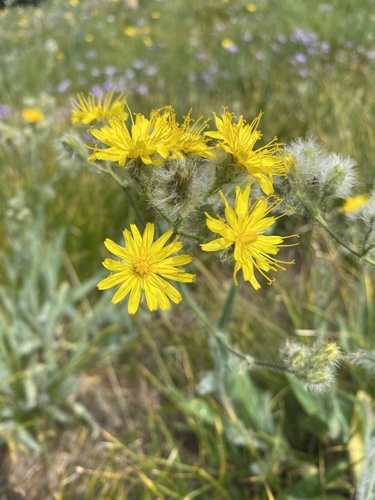
western hawkweed
Hieracium scouleri
A shaggy, silver-haired survivor of the western mountains, Scouler's woollyweed brightens dry slopes with its golden, dandelion-like blooms.
Quick Identification
Size
Grows to a height of 30 to 100 cm (12 to 40 inches) tall
Colors
Bright yellow flower heads; foliage is a distinctive pale silvery-green due to dense, long white hairs
Key Features
- Covered in long, shaggy white hairs (up to 6mm)
- Dandelion-like yellow flower heads in loose clusters
- Upright, leafy stems containing a bitter milky sap
- Basal leaves are narrow, lance-shaped, and notably woolly
When You’ll See Them
Geographic range
Where Does the western hawkweed Live?
Native to the rugged interior and coastal mountains of western North America, western hawkweed thrives from British Columbia and Alberta in Canada southward through the Pacific Northwest. Its core range includes the mountains of northern California, Idaho, and Montana, extending into the high-elevation regions of Utah and Nevada. It is a quintessential species of the eastern Cascades and the Intermountain West.
Basemap © OpenStreetMap contributors
Behavior
Western hawkweed is a hardy perennial wildflower that thrives in the sun-drenched, often arid landscapes of the American West. Unlike some of its aggressive, non-native relatives, this species is a balanced part of its native ecosystem. It spends the early spring developing a basal rosette of incredibly fuzzy leaves. These specialized hairs act as a defense mechanism, reflecting intense UV rays at high altitudes and trapping a layer of moisture against the leaf surface to prevent dehydration.
As the heat of mid-summer arrives, the plant sends up tall, branched stalks topped with multiple yellow flower heads. These blooms are a vital resource for local pollinators, particularly native bees and small butterflies. The plant is well-adapted to fire-prone environments; its deep taproot allows it to survive light surface fires and quickly resprout when conditions improve.
While it is common in the wild, western hawkweed interacts with humans primarily as a point of interest for hikers and nature photographers. Its unique 'shaggy' appearance makes it easy to distinguish from other yellow composites once you look closely at the foliage. It is rarely grazed by livestock because the dense hairs and milky sap make it unpalatable.
EverydayEarth exclusive
Camera Tips
To capture the intricate textures of western hawkweed, position your camera at a low angle, roughly 12 to 18 inches from the ground. This perspective highlights the unique 'woolly' basal leaves which are the plant's most defining feature. The long white hairs catch light beautifully, so try to frame your shots during the golden hour—just after sunrise or before sunset—to create a glowing halo effect around the foliage.
Because the plant is stationary, it is a perfect subject for time-lapse photography. Set your camera to take an image every 10 to 15 minutes during a clear summer day. This will allow you to record the 'heliotropic' behavior of the flower heads as they open to track the sun and close as the temperature drops in the evening. Be sure to use a sturdy tripod or a ground mount, as mountain breezes can cause the tall stalks to sway, leading to motion blur in longer exposures.
Western hawkweed is a pollinator magnet, making it an excellent 'stage' for capturing insect activity. If using an AI-powered trail camera with a macro lens or close-focus capability, aim it at a cluster of fresh blooms. You are likely to trigger the camera with visits from leafcutter bees, hoverflies, and fritillary butterflies. Set your shutter speed as high as possible to freeze the wings of these fast-moving visitors.
Seasonal timing is critical for this species. In the early spring, focus on the silver rosettes against the dark soil. By mid-summer, shift your focus to the tall flowering spikes. In the autumn, the plant produces dandelion-like puffballs of seeds; capturing these against a dark background as the wind carries the seeds away can result in striking, professional-grade nature photography.
Similar Species
Species that look similar or are commonly confused with western hawkweed.
Meadow Hawkweed
An invasive species that lacks the extremely long, shaggy white hairs and typically grows in wetter, disturbed meadow soils.
Orange Hawkweed
Easily distinguished by its fiery orange-red flowers compared to the bright yellow blooms of the western hawkweed.
Common Dandelion
Dandelions have hollow, unbranched stems with only one flower head per stalk and lack the dense hairy foliage of hawkweed.
Frequently Asked Questions
Record western hawkweed at your habitat
Connect a camera to start building your own species record — AI identifies every visitor automatically.