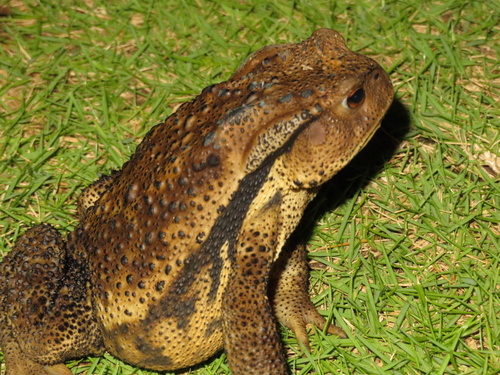
Western Japanese Common Toad
Bufo praetextatus
A stoic and nocturnal guardian of the garden, the Western Japanese Common Toad is a master of camouflage and a legendary predator of backyard pests.
Quick Identification
Size
8-17 cm (3-7 inches) in length; weights range from 100-450g (3.5-16 oz)
Colors
Variable earthy tones including olive-brown, reddish-tan, or dull yellow; dark lateral stripes often run from the eye down the flanks; belly is typically pale with dark marbling.
Key Features
- Large, prominent kidney-shaped parotoid glands behind the eyes
- Dry, warty skin with numerous bumps
- Heavy, stocky body with relatively short hind legs
- Golden-brown eyes with horizontal pupils
When You’ll See Them
Behavior
The Western Japanese Common Toad is a patient, terrestrial hunter that has adapted remarkably well to human-dominated landscapes. Unlike many smaller frogs that leap away at the slightest vibration, these toads possess a calm, almost boulder-like presence. They rely on their cryptic coloration and the potent toxins stored in their parotoid glands to deter predators, making them bold enough to sit in the middle of garden paths or under porch lights.
During the day, they are masters of concealment, tucking themselves into cool, damp crevices, under stone lanterns, or beneath leaf litter. They are largely solitary until the first warm rains of spring, which trigger a mass migration to nearby ponds or slow-moving water. This breeding period is the only time you will hear their rhythmic, chirping calls, as they are otherwise silent neighbors who provide excellent, natural pest control by patrolling gardens for slugs and beetles.
EverydayEarth exclusive
Camera Tips
To capture high-quality footage of the Western Japanese Common Toad, you must think low. Because these amphibians rarely jump and instead prefer a slow, methodical crawl, your camera should be mounted no more than 4 to 6 inches off the ground. Aiming the lens slightly downward at a 15-degree angle toward a flat surface, such as a garden flagstone or a cleared patch of soil, ensures you capture their full profile rather than just the top of their heads.
Placement is everything with this species. In a backyard setting, the best spots are 'wild' corners near compost heaps, under low-hanging shrubs, or along the edges of stone walls where they hide during the day. If you have a garden pond, positioning a camera along the damp perimeter during March and April will capture the high-energy 'scrambling' behavior of the breeding season. During the heat of summer, placing a camera near a shallow water dish or a dripping outdoor faucet is a surefire way to record them as they emerge to rehydrate.
Since these toads move slowly, your camera's motion trigger sensitivity needs to be set to high. Standard PIR sensors can sometimes miss the subtle movement of a cold-blooded animal, so if your camera allows for it, use 'Interval' or 'Time Lapse' mode during the first few hours after sunset. If using a flash, infrared (black flash) is preferred to avoid startling the toad, though they are generally less sensitive to white light than mammals. For a unique shot, place the camera near a low-voltage garden light; toads often congregate there to feast on the insects attracted to the glow.
Similar Species
Species that look similar or are commonly confused with Western Japanese Common Toad.
Frequently Asked Questions
Record Western Japanese Common Toad at your habitat
Connect a camera to start building your own species record — AI identifies every visitor automatically.