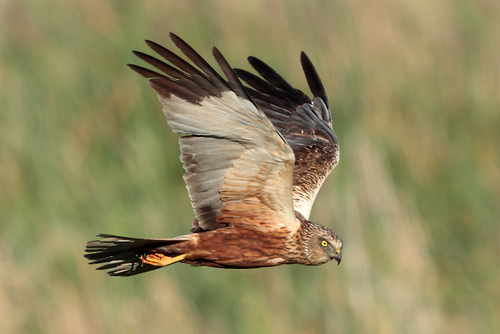
Western Marsh Harrier
Circus aeruginosus
The Western Marsh Harrier is the graceful ghost of the wetlands, easily recognized by its steady, low-level glide and iconic V-shaped wing profile. A specialist of the reedbeds, this raptor brings a touch of wild, prehistoric beauty to any landscape it patrols.
Quick Identification
Size
Length: 43–54 cm (17–21 in); Wingspan: 115–145 cm (45–57 in); Weight: 400–800 g (0.9–1.8 lbs)
Colors
Males feature tricolored wings (grey, black tips, brown) and a brown body; females and juveniles are chocolate brown with a distinctive cream-colored crown and throat.
Key Features
- Broad wings held in a distinct 'V' shape while gliding
- Long, rounded tail
- Males have silver-grey wing patches and tails
- Females have a prominent pale 'cream crown' and throat
When You’ll See Them
Behavior
The Western Marsh Harrier is a master of low-altitude surveillance. Unlike many hawks that soar at great heights, this harrier spends its day patrolling just a few meters above the reeds or tall grass. They have a characteristic 'buoyant' flight, often rocking from side to side as they use their sensitive hearing and keen eyesight to pinpoint movement in the thick vegetation below.
During the breeding season, these birds perform spectacular aerial displays known as 'sky-dancing,' where the male loops and tumbles through the air to impress a mate. While they are generally solitary hunters, they can be seen in higher concentrations where prey is abundant, and they are known for their spectacular communal roosts in reedbeds during the winter months.
EverydayEarth exclusive
Camera Tips
Capturing a Western Marsh Harrier on a backyard or trail camera requires strategic placement near the edges of open water or marshy boundaries. Because these birds hunt by patrolling regular flight paths, look for 'corridors' between reedbeds or along the margins of fields. Position your camera on a sturdy post or tripod roughly 3 to 5 feet off the ground, angled slightly upward to catch them as they glide past. If you have a fence line bordering a field, this is an ideal mounting spot, as they often follow these linear features while searching for rodents.
Since Marsh Harriers do not visit traditional bird feeders, the best way to lure them into frame is by providing a prominent landing perch. A tall, sturdy wooden post placed in an open area near long grass can act as a magnetic lookout point for a tired harrier. They use these vantage points to preen or scan for their next meal. Ensure your camera is set to a fast trigger speed and high-frame-rate video; their flight is deceptively fast, and a slow trigger might only capture a blurry tail feather.
Time of day is critical for lighting. Set your camera to face North or South to avoid the direct glare of the rising or setting sun, which is when the birds are most active. In the spring, look for the 'food pass'—a mid-air exchange where the male drops prey for the female to catch. If you can identify a nesting area (usually deep in the reeds), place your camera on the periphery facing the most likely approach route to catch this dramatic behavior. High-capacity SD cards are a must, as wind-blown reeds can often trigger sensors prematurely.
Similar Species
Species that look similar or are commonly confused with Western Marsh Harrier.
Hen Harrier
Smaller and slimmer; males are pale blue-grey with a white rump, while females have a distinct white 'ring-tail' patch.
Montagu's Harrier
Much more slender wings; males have a black bar across the wing and streaks on the belly which the Marsh Harrier lacks.
Buzzard
Heavier set with broader, shorter wings; lacks the buoyant, rocking flight style and does not typically hunt by gliding just a few feet above the ground.
Frequently Asked Questions
Record Western Marsh Harrier at your habitat
Connect a camera to start building your own species record — AI identifies every visitor automatically.