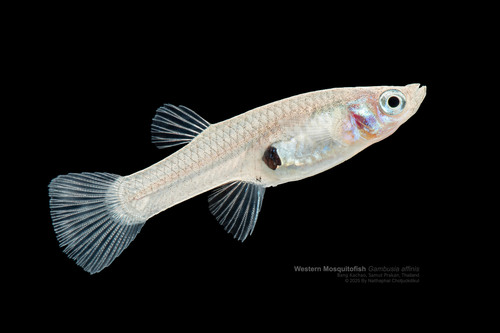
Western Mosquitofish
Gambusia affinis
The ultimate backyard survivor, the Western Mosquitofish is a tiny powerhouse known for its voracious appetite for pests and its incredible ability to thrive in almost any freshwater environment.
Quick Identification
Size
Males reach 2.5–4 cm (1–1.5 inches); females are larger, reaching 4–7 cm (1.5–2.8 inches)
Colors
Dull grey to olive-brown back with silvery-white sides; fins are mostly translucent with small dark spots on the dorsal and caudal fins; females often show a dark 'gravid spot' near the vent when pregnant
Key Features
- Upturned, terminal mouth designed for surface feeding
- Rounded tail fin (caudal fin)
- Dark 'teardrop' mark or smudging below the eye
- Flattened head and stocky body shape
When You’ll See Them
Geographic range
Where Does the Western Mosquitofish Live?
Native to the freshwater drainage basins of the central United States, particularly the Mississippi River and its tributaries, the Western Mosquitofish has become one of the most widely distributed fish in the world. Its range extends naturally from southern Illinois and Indiana down to the Gulf Coast and into northeastern Mexico. Due to intentional introductions for mosquito control, established populations are now found across nearly every state in the U.S., as well as in temperate and tropical regions on every continent except Antarctica.
Basemap © OpenStreetMap contributors
Behavior
Western Mosquitofish are highly social and energetic fish that spend the majority of their time darting just below the water's surface. They are famous for their shoaling behavior, often gathering in large groups to forage and protect themselves from larger predators. Because they lack a true stomach, they must eat almost constantly, which makes them incredibly active during daylight hours. They are bold and often aggressive toward other small fish, frequently nipping fins to establish dominance in their territory.
These fish are exceptionally hardy, capable of surviving in stagnant, low-oxygen water where other species would perish. This resilience has made them a favorite for mosquito control programs, as they can thrive in everything from ornamental ponds to drainage ditches. In a backyard setting, they are curious and will often swim toward ripples on the surface, investigating potential food sources like fallen insects or wind-blown seeds.
EverydayEarth exclusive
Camera Tips
Capturing the Western Mosquitofish on camera requires an underwater approach, as their small size and top-dwelling nature make them difficult to see from above the surface. If you are using a waterproof action camera or a specialized underwater trail camera, place it in the shallowest part of your pond or water feature, ideally no deeper than 6 to 12 inches. Angle the lens slightly upward toward the surface to capture their distinct silhouettes and surface-skimming behavior.
Lighting is the biggest challenge when filming these fish. Midday sun can create harsh glares on the water's surface that blow out the image. To get the best clarity, set your camera during the 'golden hours' of early morning or late afternoon when the light is softer and penetrates the water at an angle. If your backyard pond is shaded, you may need to use a small, diffused submersible LED light to bring out the subtle silvery details on their scales.
Because Western Mosquitofish are naturally curious, you can encourage them to 'pose' for the camera by gently disturbing the surface near the lens or by dropping a tiny amount of floating fish food directly above the camera. Use a macro lens setting if your camera supports it, as these fish are very small and can easily look like blurry specks without a close focal point. Ensure the water is clear; if the substrate is silty, place the camera on a flat rock or a small submerged platform to prevent the movement of the fish from kicking up clouds of mud.
Similar Species
Species that look similar or are commonly confused with Western Mosquitofish.
Frequently Asked Questions
Record Western Mosquitofish at your habitat
Connect a camera to start building your own species record — AI identifies every visitor automatically.