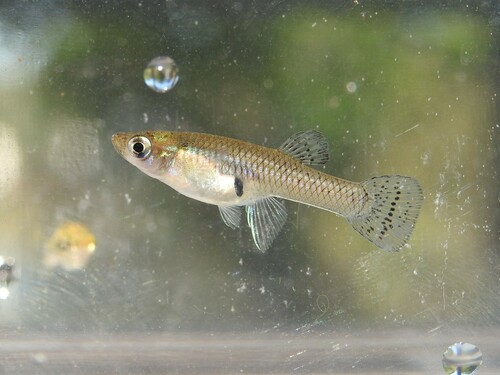
Eastern Mosquitofish
Gambusia holbrooki
A tiny, tenacious live-bearer, the Eastern Mosquitofish is the ultimate natural pest controller, patrolling the water's surface with incredible agility.
Quick Identification
Size
Females reach 3.5–7 cm (1.4–2.8 in); males are significantly smaller at 1.5–4 cm (0.6–1.6 in).
Colors
Translucent gray-olive body with a silvery-blue sheen; dark-edged scales create a diamond pattern; females have a dark 'gravid spot' when pregnant.
Key Features
- Small, upturned mouth for surface feeding
- Dark 'teardrop' mark vertically below the eye
- Rounded tail fin with rows of tiny black dots
- Males have a long, rod-like anal fin (gonopodium)
When You’ll See Them
Geographic range
Where Does the Eastern Mosquitofish Live?
Native to the North American continent, the Eastern Mosquitofish is primarily found along the Atlantic and Gulf Slope drainages. Its core range extends from southern New Jersey down through the Florida peninsula and westward into parts of Alabama and Tennessee. While native to the Southeastern United States, this species has been widely introduced across the globe to help manage mosquito populations, often becoming established in any warm, standing water source it reaches.
Basemap © OpenStreetMap contributors
Behavior
The Eastern Mosquitofish is a resilient and somewhat aggressive inhabitant of North American freshwaters. They are social creatures, typically found in loose schools near the water's surface where they scan for prey. Despite their small size, they are known for their feisty temperament; they often nip at the fins of larger fish and are highly competitive when it comes to food. Unlike most fish that lay eggs, the Eastern Mosquitofish is a live-bearer, meaning the females give birth to fully developed, swimming young.
They are incredibly hardy and can survive in environments that would be lethal to other species, such as water with very low oxygen levels or high salinity. This adaptability has made them a favorite for mosquito control, as they can thrive in stagnant ditches, marshes, and even puddles. In a backyard setting, they are constantly on the move, patrolling the edges of ponds for any movement on the water's surface.
EverydayEarth exclusive
Camera Tips
Capturing high-quality footage of the Eastern Mosquitofish requires a specialized approach since they live entirely below or at the water's surface. For the best results, use an underwater action camera or an AI-powered camera in a waterproof housing. Position the lens just 2–4 inches below the surface, angled slightly upward. This positioning captures the fish as they cruise the surface 'film,' highlighting their unique upturned mouths and the metallic blue sheen along their flanks.
Because these fish are quite small, macro focus settings are essential. Try to set up your camera in a shallow, sunny pocket of a pond or ditch where the water is clear. You can attract a school of Eastern Mosquitofish by gently tapping the water's surface or introducing a tiny amount of floating fish food. The movement will trigger their predatory instinct, bringing them directly into your camera's focal zone for a close-up encounter.
Lighting is your biggest challenge and your best friend. Shoot during the middle of the day when the sun is directly overhead to penetrate the water. If you are filming from above the water looking down, a circular polarizing filter is a must-have accessory to eliminate surface glare and reflections. Without it, your AI camera may struggle to 'see' through the water's surface to identify the fish below. In backyard ponds, try to place your camera near aquatic plants like water lilies, as the fish use these for cover and are likely to linger there.
Similar Species
Species that look similar or are commonly confused with Eastern Mosquitofish.
Western Mosquitofish
Found primarily west of the Mississippi; has slightly fewer spots on the tail fin and a different number of dorsal fin rays.
Least Killifish
Even smaller than the mosquitofish, featuring a distinct dark horizontal stripe along the body and a dark spot at the base of the dorsal fin.
Guppy
Feral guppy females look similar but have a more rounded body shape; males are much more colorful with larger, more ornate tail fins.
Frequently Asked Questions
Record Eastern Mosquitofish at your habitat
Connect a camera to start building your own species record — AI identifies every visitor automatically.